Showing posts with label Florespondence. Show all posts

Friday, 28 February 2020

Florespondence: Helle-not-so-boring

Hellebores, they aren't so boring. I'm sure that's been said a lot, but look at them - such beauty! The yellow ones are in the front garden, and the pinks and purples in the back garden.

Helleborus x hybridus Harvington yellow

A slightly chewed Helleborus x hybridus Harvington double yellow.

Helleborus 'Painted Bunting'

Helleborus x hybridus 'Double Ellen Red'

Helleborus x hybridus Harvington dusky, the second with the sunlight behind it.

Tuesday, 7 May 2019

#Florespondence: Clematis 'Eleanor'


Did you know there are alpine clematis? Well, I didn't, and when I came across this little beauty, Clematis 'Eleanor', at a plant fair last year, I was very taken with it.

Eleanor grows to only 30cms high and 60cms wide. It's an evergreen, and the flowers are a creamish-green colour. It loves full sun, but will tolerate part shade. Like all Clematis, it needs Alkaline or Neutral soil. It's hardy to H4 in the UK and zones 9, 8, and 7 in the US.


I've put it in a pot with a young Sarcococca hookeriana var. digyna 'Purple Stem'. It's a pot to give interest all year round, and sits just outside our dining room door to the garden. This is an east-facing position, so gets the morning to lunchtime sun.


Apparently it has fluffy seed heads, so I'm looking forward to seeing those. This is such a sweet little plant and a nice addition to my alpine collection.


Sunday, 7 April 2019

Daily Perennials: 1st April to 7th April 2019

Monday 1st April - Pulmonaria 'Blue Ensign'
Pulmonaria are commonly known as lungwort.


This species has the deepest blue of all Pulmonaria and is my favourite, but you can also get them in blue-pink, pink and white. The leaves are usually green with  spotted grey-white patterns on them.

You can grow Pulmonaria in part or full shade. It grows to c. 30cm high and wide over time, and looks good at the front of the border.

It's best to cut them hard back after they have finished flowering. This will rejuvenate the leaves, which will otherwise become less attractive. The leaves may remain during milder winters.

Pulmonaria are called lungwort because traditionally they were used medicinally for lung conditions. They are an excellent plant and are very easy to grow.

***bad ME, so missed a few days***

Saturday 6th April - Viola odorata
This is a semi-evergreen perennial and flowers at the end of winter/early spring. Not only does it have pretty lilac-purple flowers, the leaves are pleasingly heart-shaped.
 
I have planted some both in my new Forest Garden Border, but I've also inherited a large patch under the beech hedge between us and our neighbour, which catches the midday sun rather nicely.

On top of this, both the flowers and leaves are edible and can be added to salads. And it's well loved by bees.

Sunday 7th April - Fritillaria Uva Vulpis
This is also known as fox's grape fritillary.

Flowering in early to mid-Spring, this has an upright habit, and one stem can hold up to seven flowers. It is happy in part-shade as well as sun, but it doesn't like damp soil when dormant.

I feel it's an elegant addition to a border.


About Daily Perennials
#DailyPerennial #Florespondence

Sunday, 31 March 2019

Daily Perennials: Thu 28th March to Sun 31st March 2019

Thursday 28th March - Chionodoxa forbesii
For my first #DailyPerennial I give you: Chionodoxa forbesii which is also known as ‘Glory of the Snow’.

It’s a fabulous Spring blue, though it’s only 10 cm tall. It looks good at the front of a border, in containers or under deciduous trees. You can also naturalise them in grass, and they will happily self-seed. You can also get pale pink and white Chionodoxa.

In this picture you will notice a little black beetle on them. This is a pollen beetle. It doesn’t cause any damage to the flowers, and in fact it an important pollinator for Oilseed Rape. Just remember to give any flowers you cut to bring inside, a good shake outside first to dislodge any of these beetles so you don’t end up with them in your house!

Friday 29th March - Tulip Turkestanica
Tulipa turkestanica is also known as a 'species tulip'.

Species tulips are those that haven't been hybridized and are from where original tulips descend. The Turkestanica species come from either Turkey or Turkestan - my research came up with both for it's origin. It's a dwarf tulip, only coming to 30cms high.

It can have up to 12 star-shaped flowers per stem, quite a lot for a dwarf tulip! It likes full sun and because it's small, should be placed at the front of a border. It grows happily in pots, and in heavy clay soil if you add some grit/sand when you plant the bulbs.

Like all bulbs, let the foliage die back naturally. This is the time that it captures and stores the nutrients and energy back into the bulb for next years flowering.

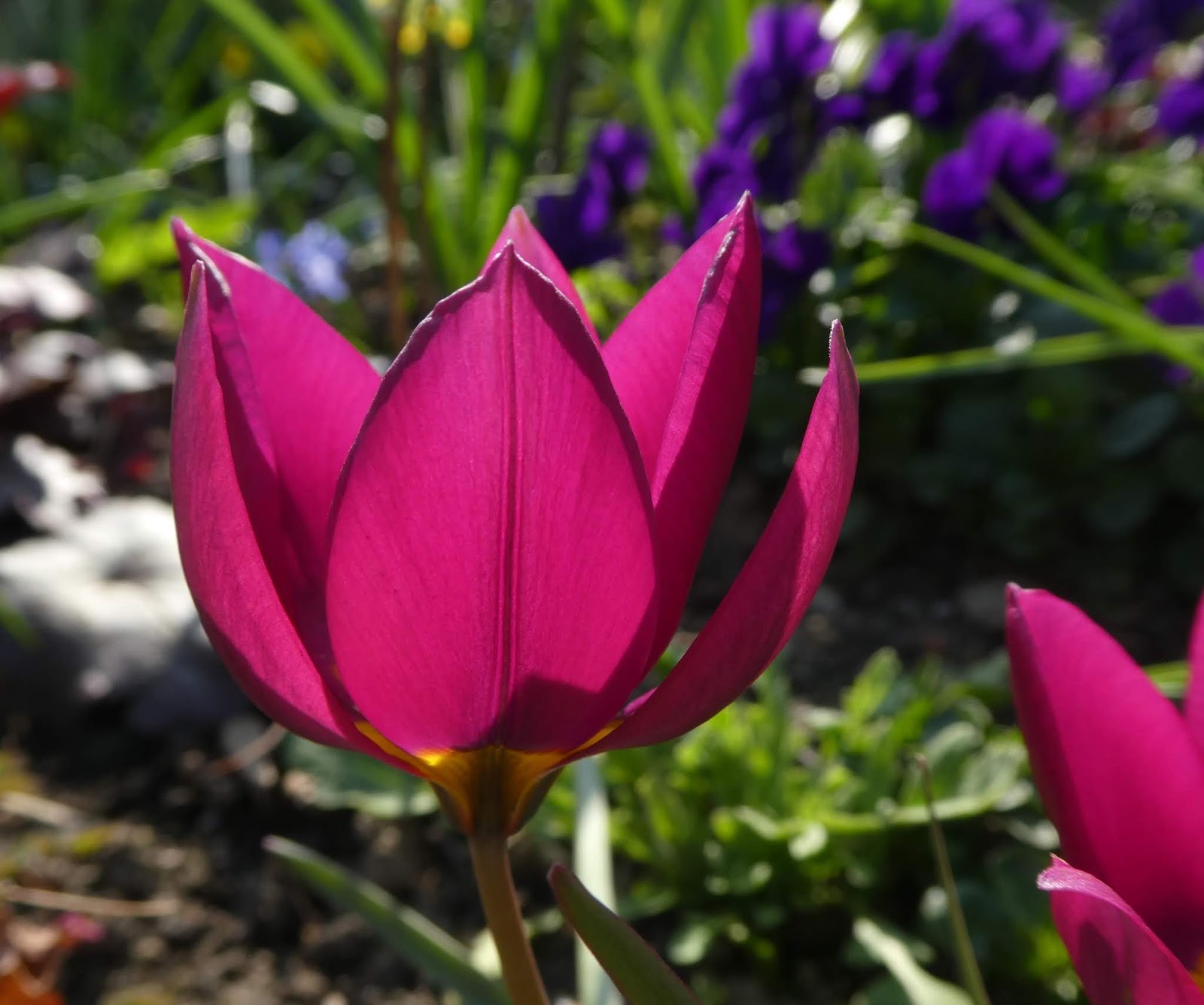
Saturday 30th March -  Tulipa Humilus Odalisque
This has the most fabulous deep pink-magenta petals and it's quite the star in the border. The petals open when the sun is on them, then closes when it goes.

It has the same growing requirements as the previous species tulip (above post). It also has a sweet-spicy fragrance that stays with you. It's another favourite will pollen beetles too.

T. Humilus Odalisque is only about 10cm high, but it really has the wow factor.

Sunday 31st March - Fritillaria persica
This is also known as the Persian Lily.

These can grow up to 1.2 metres high. Mine about about 90cms, but it's their first year growing. They need a sunny spot and well-drained soil.

You plant most bulbs at twice their depth, but for F. persica, you plant then 4 times their depth. The bulbs themselves are c. 10cms wide and tall.

I think they are very beautiful, and are a dramatic addition to a border.


About Daily Perennials
#DailyPerennial #Florespondence