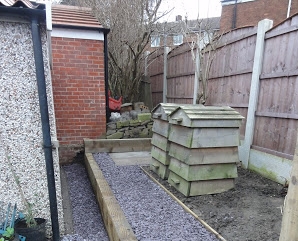
It's been just over 2 years since the landscapers completed the work on my garden, and it's only now that I finally have the large water tank in place that was originally part of my design.
You can see the paving stones to the left of the compost bins, ready and waiting for the planned water tank. The plan was to maximise the yield from the large roof (c. 20 m²) of the garage by putting in a large rainwater collection tank, from which I could water much of my back garden. It was a good plan. However, I had run out of funds to pay for the large tank I wanted, which was going to be c. £400 or more. Then I got distracted by other things in the garden. So it was only last month that I finally thought I should face up to this glaring omission to my original plan and actually start saving and getting in a water tank.
Whilst I had done some general Googling to find out who sells rainwater tanks for domestic use, I also asked people on Twitter for recommendations of a good source for one. This is where it got interesting. As ever, Twitter gardeners are a wonderful source of information, and thanks to suggestions from
@littlerobbergrl,
@dr_mark_allen and
@BTOCarms, I discovered IBCs.
IBC stands for Intermediate Bulk Container, and they are used for transporting food products, including juice. They all seem to be 1000 litres tanks. Whilst you can buy a new IBC for £150, you can buy a recycled one for £56. From what I gather, a recycled IBC has been cleaned out so is clean for rainwater collection purposes, but no longer meets food standards so cannot be reused in the industry. So you are upcycling and getting a bargain.
A standard water butt is c. 200-250 litres, so getting in an IBC is 4 to 5 times your every day butt. An added bonus is that a 2nd IBC can easily sit upon the 1st one, if you have the right elevation for collecting rainwater. Unfortunately I don't, so it's just the one. But 1000 litres is a lot of water, so I'm not bothered.
The container was delivered a week ago*, and after getting in help from the neighbours to lift it and carry it up to behind the garage, it was in place for Kevin to then sort the guttering and piping for me.
Water is collected from guttering on both sides of the garage, then piped to a filter point on the back of the garage. The filter is to stop leaves and other debris from getting into the tank.
This is then taken to the IBC by another pipe, and filtered a second time before the water goes into the tank.
Yes, that's a food sieve. I had been using it to winnow saved seeds but it was too fine, so I re-purposed it for the water tank. Thanks to all Kevin's work (and yes, it's been tested & it works), below is the result - ta da!
You can purchase a tap fitting (as I did) that can then be used with normal hoses, such as Hozelock. We added a bit of hose pipe which I can use to fill watering cans. Once the tank fills up to a certain point and creates enough pressure, you can add a longer hose pipe with a nozzle to use for watering like you would a hose from a normal tap. I plan on purchasing this soon.
But for now, I have to wait for it to rain.
UPDATE 7pm: it's been raining! And the rainwater collection is working perfectly; we have our first 100 litres.
UPDATE 28th March, 11am: we had 32mm of rain last night, and with our roof at c. 20 m², the tank is now filled up to 750 litres!
*I got my IBC from a company in Wrexham,
DVC. Delivery was £40 and if you do get 2 containers, it's the same delivery cost. All up, including delivery and the extra piping and bits we needed, it came to £128. Much cheaper than £400(!), which is why I didn't have to save for long :)
* * * * *
Not the most exciting blog post ever, but I thought it might be of interest to others looking for a similar solution for rainwater collection.