Showing posts with label Brassicas. Show all posts

Monday, 18 August 2014

Garden visit: Easton Walled Gardens

We often make journeys between Sheffield and Cambridge to visit Kevin's mum. It just so happens that along this route, the A1, sits Easton Walled Garden. We had visited in late Spring 2013, so this was our second visit to the garden.

The garden is in Lincolnshire, and the site was originally covered in trees. In just 13 years the garden has grown to the space that is loved by many, including Kevin and I, today.

Some areas are more intimate, such as the Pickery (cut flower garden) and Vegetable garden. Alternatively, the Main gardens give a gracious sweep that includes meadows, the Long Border and the Orchard, mixing formal and informal, and situating the garden within context of the house, and the countryside in which the house and garden sits.

Take a stroll around the garden with me now...

The Pickery, with a large selection of cut flowers. All flowers in the Pickery are grown from seed each year.

The Pickery includes over 80 varieties of sweet peas. Although the peak time for sweet peas was over, there were plenty still in flower and giving fragrance. Here are my favourites of the day, of which I availed myself of seed  :)

Lathyrus odoratus 'Black Knight'

Lathyrus odoratus 'Pluto'

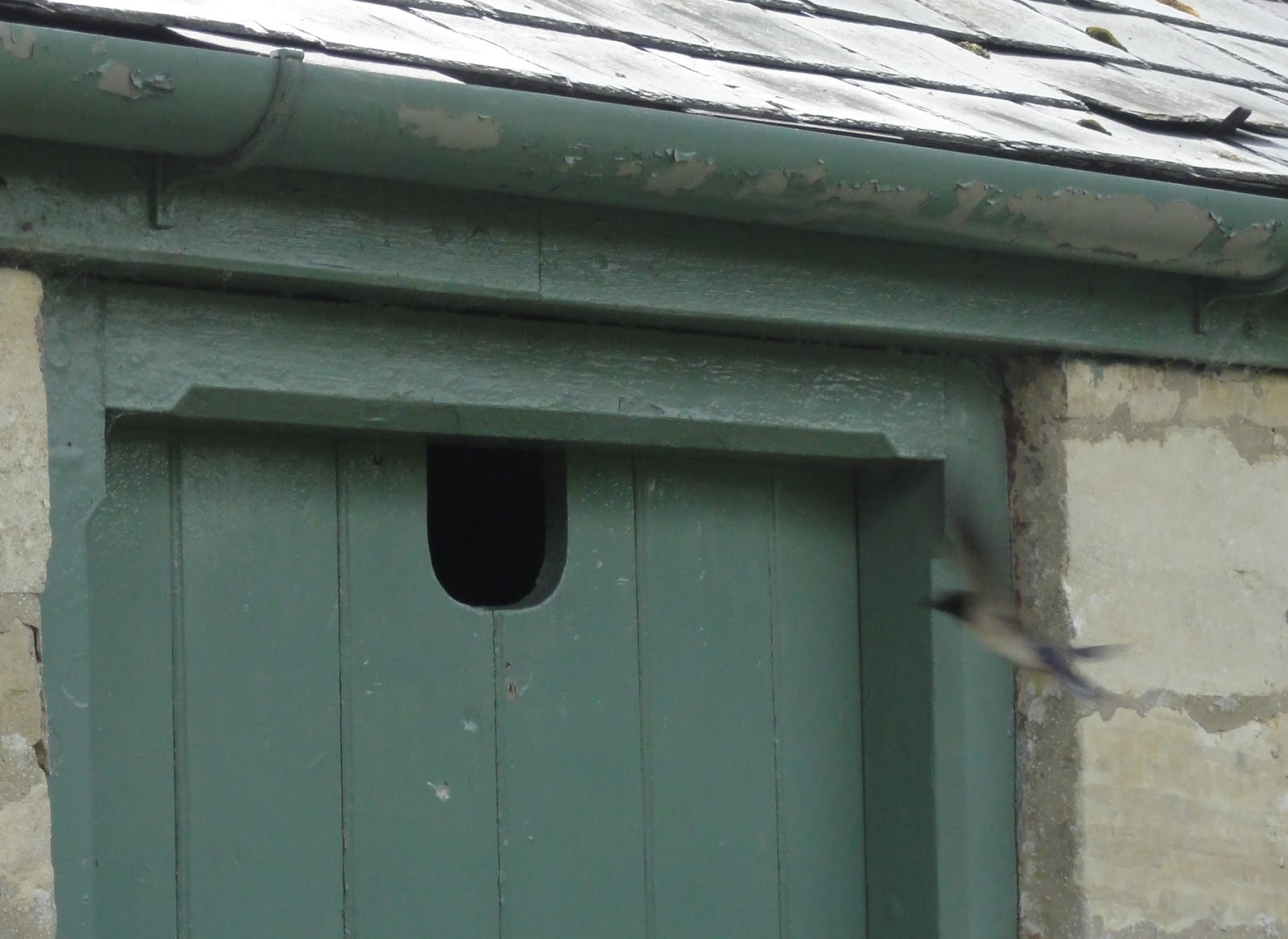
In the Pickery, out of the corner of our eyes we thought we saw something flash past us into the hole in a door. It took a while to work out what bird it was as they were very fast, but finally we saw it was a swallow. Blurry photograph, as they are so quick!
I thought this staging was very pretty. It reminded me of Helen over at Patient Gardener, who has a staging that changes with the seasons. This is an idea I plan to copy in my own garden at some point in the future.

The Vegetable garden food is harvested and used in the cafe. The cafe has lovely food and you can eat your lunch or afternoon tea whilst looking over the Pickery.

I loved these brassica cages, different sizes for different brassicas. Although short now, those Brussels Sprout or Purple Sprouting Broccoli plants will increase in size considerably over the coming months and will be protected from wood pigeons and the like. It made me realise I really should separate out my own brassica growing into cages/coverings that suit the type of brassica growing. Of course, my garden is considerably smaller, so not as easy.

In one of the greenhouses I spied these brown paper bags hanging from the ceiling. This is sweet pea seeds drying out for sowing and selling next year.

In the other greenhouse, we were both taken by these very long podded plants. It's Vigna unguiculata subsp. sesquipedalis and it's common names include: yard long bean, cow bean and snake bean. I'm curious to know how it tastes. Cow bean?!

The other green house had very happy healthy cucumbers and tomatoes, both trying to get out the windows!

From the Greenhouses you can get a wonderful view over to the Main Garden.

The terraced meadows are just wonderful. In many ways this was our favourite part of the garden. You could hear the grasses swaying in the wind and see butterflies and bees on the wildflowers. It is so pretty, and so elegantly executed. Views from and back towards the terraced meadows also reveal how well the garden is situated within the landscape. The farmed land complements the garden, and vice versa.

View of the meadow terraces from the Long Border.


The Long Border was very peaceful. In that I mean, though there were some shouts of colour from orange daylillies and others, on the whole the colour palette was quieter, with lots of lighter purple tones and white. Very peaceful on the eye.

I was particularly taken with this splash of colour in the Long Border. It is Linum grandiflorum 'Rubrum' - the crimson flax flower and I'll be ordering some seeds of this to grow in my garden next year.

View from the other end of the Long Border. The relaxed planting style meant that plants like Nepeta (catmint), were allowed to do their thing and not be rigorously cut back as they spilled over onto the pathway. 

More splashed of colour in the Long Border from pink roses. And you can see the Yew walk, well, the Yews at least, behind it.

We didn't explore the Orchard or Woodland as I was too tired to go further. We did manage to stop by the cafe again, for cake. Well, it was on the way back! Nearby the cafe is this wonderfully espaliered pear tree. Those pears looked quite fine. I wonder if that means pear in cake in future? Yum.

I loved the blend of formal and informal together at Easton Walled Garden, they do it beautifully. We will be dropping in again on one of our future trips to/from Cambridge.

Monday, 2 May 2011

It's darned windy out there

It's bloody windy out there. So on top of the almost complete lack of rain, we now have high winds drying out the soil. Ugh.

Kevin and I spent a couple of wind-blown hours at the lottie this afternoon. In mid-March we had set up a frame for protecting the brassicas. However, the wind rather ruined that. Like many allotment sites ours is very open with little in the way of trees or hedges to help reduce wind damage on the allotment. In fact I'm quite lucky, as I do have a bit of a hedge half-way down on one side, and this will offer protection to the future beds that are not yet planted... Back to the frame; a week after putting it up we returned to find it had gone! A bit of searching found it several lotties over and caught up on someones shed. So we rescued the frame and cover and decided to rethink our plan for protecting brassicas.


Thanks to Kevin, we have hopefully come up with a solution. If you look carefully (ok, very carefully!) at the picture above, you will see that there is some white rope from the top of the middle frame going down into the ground. Kevin has tied this to a brick, and buried it deep down. But not just that. He has used really large tent pegs at each corner and also tied these into the frame, also burying them deep down. The frame now feels quite solid and in place. The cover has gone on, this time a fine mesh cover so that it stops the horrid white cabbage moth but lets in air and rain, if we ever get any rain again... This is the final result.


We are really hoping that this has solved the problem. I'm hoping to drop by on Wednesday afternoon to check if it's still in place. If it can deal with the current winds, then it should be ok!

Before putting on the mesh I planted out some of my brassicas, including the stakes for things like brussels sprout and calabrese, which get tall and will also need staking to stop wind rock. I have learned from experience that it is better to put in the stakes at the same time as puting in the young seedlings. It makes it easier to tie them to the stake as the grow and keeps them steady (preventing wind rock).

Stakes next to the young brassica seedlings

Because of the dry and windy weather, I'm planting seedings in a bit of a dip. This is to help contain some of the moisture and give a little protection against the wind whilst it is still quite fragile. This, by the way, is a theory of mine I'm trying out. Time will tell if it actually helps or makes a difference!

By the time we got ready to head home, I thought the lottie was looking pretty good. Strawberries, broad beans and garlic all doing well. Some young chard and spinach just coming up, some brassicas in, as well as some carrots, parsnips and beetroot. And Kevin got another bed ready (the one immediately behind (not beside) the brassica frame) - yay Kevin!

Tuesday, 15 March 2011

Early spring at the lottie

With my back much improved and the sun shining, Kevin and I got down to the lottie on Sunday. It was well and truly time to get the green manure beds dug over, which is what Kevin is doing here.


This is Vicia sativa (winter tares) which I sowed late last September. It's hardy, it survived a couple of feet and several weeks of snow, and it's a nitrogen fixer. Digging it in, I'll leave it for a few weeks to rot down and release the nitrogen, and will then be planting my brassica's in this bed. Brassicas are nitrogen hungry, so hopefully this will help them grow big and strong.


Whilst Kevin was digging in the green manure, I was trying to rescue my strawberries from encroaching couch grass. I also grow narcissi with my strawberries, so I have some early spring colour to lift the spirits and make me feel the growing season is really starting.


The garlic is coming along nicely, as you can see here. Over winter, I have been trying out the many different varieties I harvested last year. Some, such as Irkutsk, are way way WAY too strong even for me, and I love garlic (no, really?). We used a quarter of a clove in an omlette and it was not only overpowering, we had garlic breath for days! Most aren't that strong and it's been fun trying them out in key dishes (ie. pasta sauces) to see what difference each makes. I'll update the garlic varieties record sheet in the next month or so, which will include how they are storing.


The lottie next to us has an unintentional pond. An 'unintentional pond' is a hole that started as a, well, hole, and then started collecting water and then frogs started spawning and so then Tess, the lottie holder, decided to more intentionally turn it into a pond. The black clump to the top middle-right is this years frog spawn. We do get lots of frogs around our beds, which is great as they eat the slugs. However it can be a little nerve-wracking at times, nearly putting a fork into a froggie! I try and return them to the pond, however they don't seem to get the message and it's an ongoing saga. In summer the pond can dry out a bit, so we help out adding water to keep the frogs from being parched.


By the end of a couple of hours work, the green manure was dug in, I rescued most of the strawberries from couch grass, gave the asparagus bed a bit of a mulch (furthermost right), and got up my new polytunnel. At the moment this is over the broad beans to help them along a little, but mainly it's going to be for the brassicas. It will protect them from blasted pigeons and the dreaded white cabbage moth. Learning from previous experience, I'm going to mollycoddle my brassicas and keep them protected all year round. It will be me eating cauliflowers, cabbage, kale, brussel sprouts and broccoli and not the naughty beasts!

Tuesday, 26 January 2010

Post-snow lottie: the results

It's been a couple of weeks since I've blogged. I've been finishing up at my job at INASP and busy applying and preparing for interviews and it's rather taken over a bit. However, I did finally get down to the lottie the other day and can now report on what did and didn't survive the heavy snow.

First up is the Broad Beans. For over-wintering, I had planted Aquadulce Claudia, The Sutton and Crimson Flowered. The Crimson Flowered (left) were just a trial. I had only ever planted them in spring before and have found that the blackfly rather likes them and this could inhibit growth. Though the flowers were very pretty, crimson (!), I found if you didn't get to picking the beans quick enough, they would not taste as good (though ok for a Lebanese Fava Bean dish, I think the corriander, garlic and lemon helps). So I didn't know what to expect by planting them in autumn. As you can see, they have done very well and of all my broad beans, these are the perkiest post-snow. Will be interesting to see how they grow into spring, and the onset of the dreaded blackfly in late-spring-early summer.


Aquadulce Claudia (right) is known as THE broad bean to plant for over-wintering. However, as you can see here, they are looking a little sorry for themselves. Some of the beans haven't germinated either, although maybe some got nicked by mice. I'll sow some more come February to fill in the missing plants.

My third type of Broad Bean, was The Sutton (below). This was another experiment. It is said these might be sown in autumn, so I thought I would give it a go. They are looking ok, better than the Aquadulce Claudia, though again some missing plants so will do another sowing in February. Also, it is possible I should have planted them under cloches or cover for autumn sowing. Will try again next autumn and see what happens. I haven't grown The Sutton before, so just going hearsay that they are a bean worth trying. Overall, I'm pleased that the broad beans largely survived the heavy snow. Yes I have to sow a few more plants in Feb, but I tend to find this happens most years when there hasn't been heavy snow, so feel the overall success rate has been good.


Now, onto a failure. Not, I hasten to add, because of the snow, but because of, I suspect, Pigeons. Look at my poor brassicas! If you look carefully, you will see that the tops have been ravaged. During summer and autumn I did have agricultural mesh covering them in a cage to protect them from the darned Large White cabbage butterfly, but then removed it for winter since the butterfly is not around then.


I recall someone at the Lotties expressing suprise that I had taken down the mesh cage at the time, mentioning they might get attacked by pigeons. However, based on previous experience, I wasn't worried. SILLY ME. Previous experience was based on growing brassicas in the back garden in Witney, where we had Merlyn the cat prowling around, stalking pigeons and anything else that moved. I didn't have any problems with pigeons there. But Merlyn doesn't get down to the lottie; really, he needs to do more to earn his keep. Just shows you how contextual growing is. Suffice to say, next year the agricultural mesh cage will stay on!

Returning from the 'dark side', I can happily report that my carrots, d'Eysines Large Half-Long (right) that I have been growing under cover, are doing absolutely fine. Look at the happy bunnies.
 
More interesting, is the how the lettuce Winter Density has done. On the left are those that were growing completely in the open. They are looking rather sad, but if I'm lucky and we don't get any further snow they may perk up and get growing again. On the right are those that happen to have been sown next to the carrots and therefore got a bit of protection from the cloche covers I put over them (you can see the make-do cloche covers below, just a bit of perspex from a broken mini-greenhouse). These are doing much better and I have confidence they will definitely continue to grow and I should be able to pick lettuce once it warms up again. And what has this taught me? Put my Winter Density under cover and I'll be able to pick lettuce through the winter. Guess what I'll be doing next year...

Finally, still no sign of the garlic. I guess the snow kept them dormant for longer (I think that's what happened, does anyone know if this is right or wrong?), but hoping that the unfreezing will now mean they kick into action. Here is an overview picture of the lottie beds post-snow (plus those 'cloches' I'm using for the carrots). Might look neat, but I happen to know that the weeds have already started growing. Next job.