Showing posts with label Garlic. Show all posts

Friday, 30 August 2019

Garlic giveaway 2019

Update Thursday 5th September 2019
This offer has now been oversubscribed, so I can not take any more requests

Garlic drying in the sun

 My garlic did really well this season. I've sorted through it, what I'm keeping to sow in Autumn, and what I'm saving to eat through the coming year. And I have enough to also do a bit of a garlic giveaway!

I've included some basic info below, but if you'd like to know more about the individual varieties, do take a look at my Garlic Record. If you would like to know more about growing garlic in general, please read my Spoonie Veg: garlic post first.

As there is only 2 packs (each pack contains 5 cloves) available for each variety, you can choose up to 2 varieties you'd like to try. Or I can choose for you if you're not bothered. Then email me your address details to: jgp @ cooptel.net. I plan to send these out in batches, during September. Note: if I get inundated with requests(!), then I might reduce it to 1 variety per person, so more people have a chance to try them.

Due to postal restrictions, this giveaway is only available to people in the EU/UK. This offer is available until 22nd September 2019, and is on a first-come, first-served basis. And yes, this is a free offer :)

Garlic ready for harvesting, at the end of July

Varieties available
Unless otherwise denoted, the variety has a medium flavour, and will grow ok in pots.

Georgia Fire: storage 4 months.

Martin's Heirloom: storage 5 months.

Metechi: medium-strong flavour, storage 5-6 months, not happy being container grown.

Music: storage c. 5 months.

Persian Star: storage 4-5 months.

Rosewood: storage 5-6 months

Silver Rose: 6 months, not happy being container grown.

NOW GONE Susan Delafield: storage 6-8 months, this is the best variety if you want to grow in containers.

Apart from Silver Rose, which is a Softneck garlic, all other varieties are Hardnecks (see below). All can be sown in Autumn (October/November).


General information
Hardneck garlic: Allium sativum var. ophioscorodon: always produces a flower stalk (called a scape, see photo at the bottom of the post), is considered to have a stronger flavour, and is considered to have shorter storage qualities.

Softneck garlic: Allium sativum: doesn't produce a flower stalk unless stressed, has better storage qualities.

Soil: alkaline to neutral soil. Do not grow in acid soil. Most don’t do as well in heavy clay, garlic needs decent drainage.

Storage: the length of storage time is based on the conditions I have stored the garlic (more about this in the Spoonie Veg: garlic post).

Container growing: you can grow garlic in containers. I found 3 cloves per 10 litre pot gave me the best harvest. See my Container grown Garlic experiment post for more information.

Posts about growing garlic:
Spoonie Veg: garlic (for an overview of growing garlic)
Container grown garlic experiment (optimal conditions for growing in containers)
Garlic scapes (for Hardneck garlic varieties)
Getting the garlic in (sowing garlic in Autumn)
Garlic Record: my record of growing these garlic varieties since 2010. It gives more detail on the growing of each variety
Garlic growing back in June, with a garlic scape, which is edible too.


Thursday, 6 June 2019

Garlic scapes

Garlic scapes grow on Hardneck Garlic, and occasionally on Softneck Garlic (usually if stressed). If you aren't sure what type of garlic you are growing, you'll know if it starts producing a scape, which develops around late May and early June in the UK.

You need to remove the scape as otherwise the garlic plant will put all it's effort into creating 'bulbils' (miniscule bulbs) in the scape, as the expense of the bulb in the ground.

1. A garlic scape just developing.

2. The scape has further developed and is leaning over.

3. The scape has now turned into a hook.

You want to snap off the garlic scape as soon as you notice it. This is because the plant will put all it's energy into developing the scape, at the expense of the bulbs in the ground. The scapes turn into flowers that produce 'bulbils', tiny bulbs, which are interesting per se, but not if you want to actually harvest some garlic bulbs!

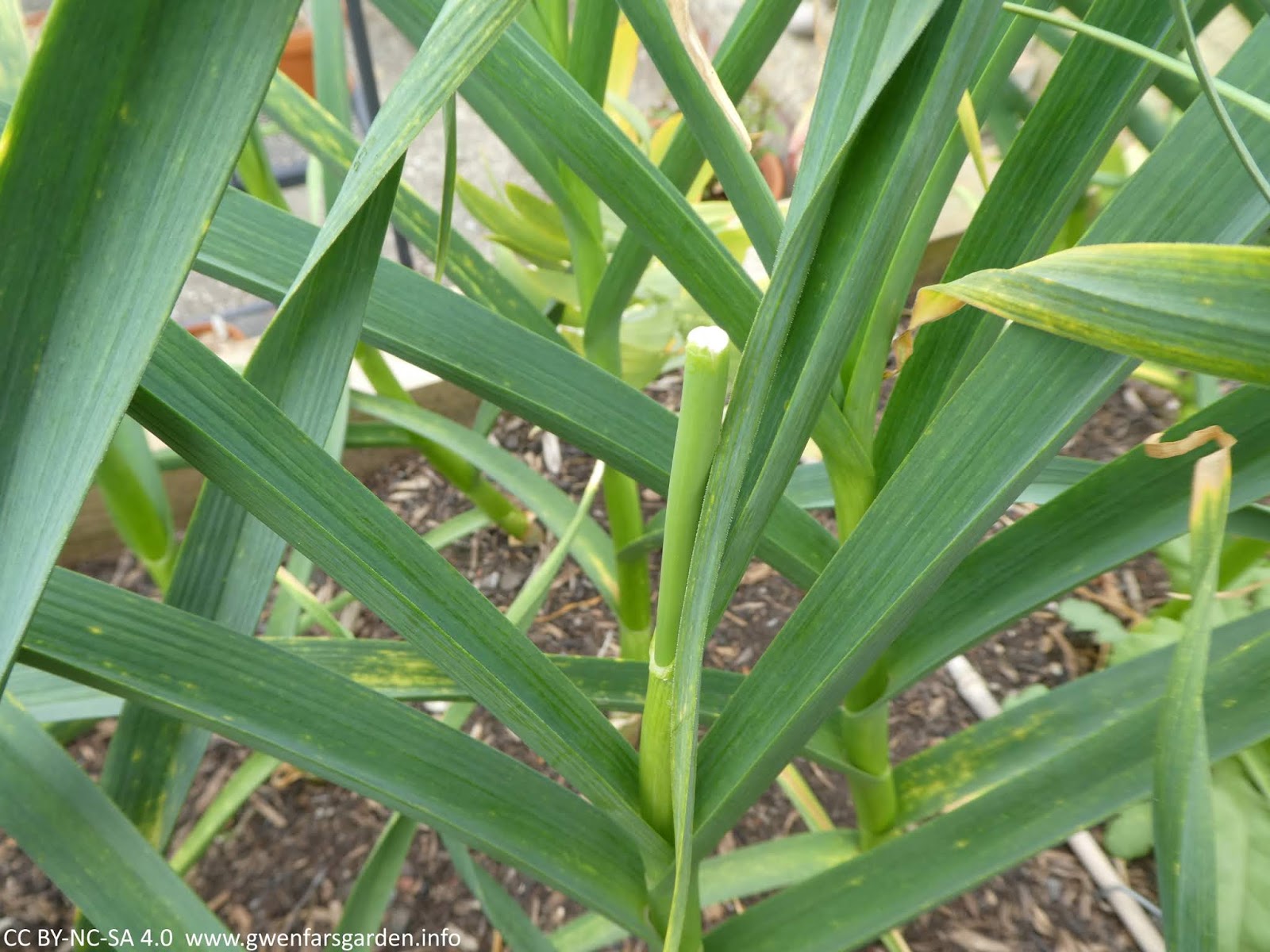
4. Snap the scape off at this point.

5. The scape section left of the plant may still grow a little more, but will then stop, viz:

6. Don't waste the garlic scapes, as they can be eaten!

A lot of people make Garlic Scape Pesto (think normal pesto but with garlic scapes included). However, I tend to just chop it up and add it into whatever I'm cooking at the time, such as omelettes or a curry. You can add it into any dish you might add garlic to. The Garlic Farm have a good list of suggestions if you want further inspiration. The scapes have a milder flavour compared to the bulbs.

So, if you notice these developing on your garlic, now you'll know what to do with them.

Updated: 1st June 2020

* * * * *
If you would like to know more about growing garlic, do check out my Spoonie Veg: Garlic post.


Sunday, 19 February 2017

Gardening with ME: some beans


It is a truth universally acknowledged, that a gardener without a garden, must be sad sight indeed.

Ok, I'm not completely without a garden. But between selling our house, moving, and my ME being bad, I've not been able to venture into the garden recently, so I've felt like I've had no garden. Today I cracked. I said no to boxes needing unpacking and dealing with the unending list of moving-related chores to be done. I decided to use most of my spoons in the garden, to sow some beans.

Because we are moving and I'm going to be gardening in containers for the next year, I couldn't sow a lot of beans. In fact, I sowed six broad beans seeds of The Sutton in total. That's all I could fit into the container above (the one with the compost, not the alpine planter!), and the limit of my spoons. But I sowed some beans! Here is a better photo.


Better, in that a container just showing compost and a label, is a bit boring. So this picture includes the round pot with some of my beloved snowdrops, Galanthus nivalis f. pleniflorus 'Bagpuize Virginia' that I've dug up to take with me. Also coming with me in that pot is Clematis x triternata 'Rubromarginata' and Lavandula 'Regal Splendour'. In the rectangle pots behind is some of my garlic. Trust me, there is garlic in there, not just more compost.

See, garlic shoots! Silver Rose is the first to send up some shoots.

I did manage to take short walk around the garden to see what is flowering now. To enjoy some blooms before we move.

Here is the rest of the Kingston Bagpuize snowdrops, which remain behind for the new owners. Looking pretty among the strawberries.

Hellebore... I've lost the label, but heck, it's pretty regardless of it's name.

A blurry photo of reticulata Iris 'J.S. Dijt'. I've lost my camera so all these photos are from my mobile phone. Blurry or not, the colour is fabulous.

Sarcococca confusa with, oh, what a fragrance.

A burst of sunshine, Eranthis hyemalis.

And Iris 'Katharine Hodgkin'.

So I have sown enough broad beans for say, two meals. Not a lot. But I'll take what I can get.

It is a truth universally acknowledged, that a gardener with ME who has spent even a small amount of time in the garden, must be a happy sight indeed.


* * * * *
I'd love to hear your thoughts and comments on your experience, so don't be shy!

About Spoonie Veg    About Gardening with ME

Twitter hashtags: #GardeningWithME #SpoonieVeg

Recent Gardening with ME and Spoonie Veg posts...
 Gardening with ME: a floral review of 2016
 Spoonie Veg: Broad Beans
 Spoonie Veg: garlic

Friday, 16 September 2016

Spoonie Veg: garlic


Spoonie veg rating: 1

Garlic, my number one vegetable. I adore garlic and have been growing and saving my own for years. It's wonderful in the kitchen, complementing so many dishes, and it is also very easy to grow. It's up there with Sorrel as being one of the easiest Spoonie Veg to grow.

This post goes into a bit more detail than my usual Spoonie Veg posts. This is because garlic is one of my 'specialities' (the other being potatoes) and I save cloves from each season to grow the following year. But it's also because garlic is so easy to grow and save your own cloves, that I thought it was worth including the extra detail. Just remember I am an amateur, and all information is based on my c. 10 or so years of growing garlic, but isn't expert.

In my post introducing Spoonie Veg, I gave Garlic a rating of 1. That being: 1-2 requires few spoons, 3-4 moderate spoons, and 5 hard, lots of spoons needed in order to grow that fruit, veg or herb.


Growing
There are two key types of garlic, Hardneck and Softneck garlic. The main differences between them are:
  Hardneck garlic, Allium sativum var. ophioscorodon: always produces a flower stalk (called a scape), is considered to have a stronger flavour, and has shorter storage qualities (more on that later).
  Softneck garlic, Allium sativum: doesn't produce a flower stalk unless stressed, has better storage qualities.

Otherwise they share the same growing conditions. Like most vegetables, they don't like acid soil, but do like well-draining soil. A lot of people have problems growing garlic in clay soils. At my old allotment in Oxford I was growing on heavy Oxford clay and interestingly found some of hardnecks did ok despite this, for instance, Georgia Fire and Persian Star. Here in Sheffield my soil is the wonderful combination of acid and clay, which is why I have 45cm deep raised beds. These have been filled with compost and well-rotted manure with a top up each autumn. This has worked well with growing garlic and I always get a good harvest.

Depending on the variety you can sow either in Autumn or Spring. I always grow autumn-sowing garlic, sowing October/November. This preference is mainly due to liking to know something is growing in the kitchen garden over winter! But there is also a practical reason, in that garlic generally needs a period of cold (0 degrees and below) to break it's dormancy. A warmer winter can mean you end up with small bulbs, or even just one big clove.

I space the garlic out first in a zig-zag pattern, then push it in so it is covered by about 3-4 inches of soil. If you have heavy clay, just put it a couple of inches. See my 2012 post on Getting the garlic in for more detail about planting including spacing.

Once in the ground, there is very little to do until about mid-Spring. The key maintenance task with garlic is watering. This is key during the peak growing period (approximately April-June) or during a dry Spring. I also give them a feed of comfrey liquid a couple of times during April-June. Also keep on top of the weeds so they don't take nutrients away from the developing bulbs.

If you are growing Hardneck Garlic (most of mine are), then you also need to watch out for the garlic scapes coming up around May/June, as in the photos below. They come up straight then turn into a hook. These need to be cut off as soon as you see them, as otherwise all the energy is put into the scape and you end up with small bulbs. On the plus side, the scapes means you can make garlic scape pesto. I've also use them instead of garlic cloves in a recipe, one scape equals one clove. Softneck garlic does not produce a scape (unless stressed) so you don't need to look out for them.
   
  
Garlic scapes. On the left is the young scape just showing, on the right when it's turned into a hook.

The main disease garlic is susceptible to is garlic rust (the same thing leeks get), but this doesn't actually affect the bulb so is only a cosmetic problem. One I never bother worrying about.

You might notice the tips of the leaves starting to yellow a bit from April onwards. Don't worry about that unless the whole plant is dying off. If the latter is the case, it most likely means they need a lot more watering.

Garlic harvest drying in the sun

Harvesting usually starts from July. Basically, once the full plant starts dying back (and not just the tips going yellow), you don't need to do any more watering and you can start to dig up your garlic. Having a chronic illness means I fit digging garlic up around my health. It can mean I might have left them in the ground for too long, in which case they might start splitting. However, I don't worry about splitting as I haven't found it affects the taste or storage qualities of the bulb.

The bulb on the right started splitting

Growing garlic in containers
Garlic can also be grown in containers. I've recently blogged about my experiment of growing garlic in containers, so visit that post if you would like to know more about it. You won't get as big bulbs growing in containers, but I did find that 3 cloves sown in a 10 litre pot will give you the equivalent of 2 bulbs grown in the ground or raised beds.

Harvesting and sorting
Once I've harvested the garlic, I cut off a bulk of the foliage just leaving a short stem. I sort through to make sure I pull out any that are going mouldy. This isn't many, just those that weren't as strong or where water got into clove. I then dry them out for a few weeks.

Garlic drying out after harvesting in my garage.

I then do a second sort through the bulbs and clean them. This consists of cutting off the roots and taking of any dirty layers of the outer bulb skin. At this point you can better assess the bulbs for saving and storage. I separate them out and then allow them all to dry out for another couple of weeks.


Saving cloves to plant the next season
If you have a chronic illness then you might want to skip saving your own cloves, and instead buy new ones for sowing in Autumn. That's what I do with most veg now as I don't have the energy to save all my own seed as well. However, because garlic is my 'thing' and I'm growing hard-to-get varieties, I'm willing to use extra spoons saving these and growing them on the following season.

The following picture shows the garlic cleaned up, with the best ones in a separate bag which I'll use for planting in October/November. And yes, that is pharmacy prescription bags being repurposed as bags for storing garlic.

The very best bulbs that have the most number of outer cloves and clearly have no disease etc, are then separated out for saving. I've been compiling a Garlic Record (see end of post) to compare each variety to past results. For saving garlic, like with seeds, having a larger number of plants in the first place from which to choose those for saving, is best. As I only have a small garden I cannot do this. However, I've been growing these varieties since 2009 and I am not having any problems with a decrease in vigour.

Storing
Hardneck garlic isn't meant to store as well as Softneck garlic. The RHS says only until mid-winter. However, I've found that in optimal conditions, my Hardnecks all store just as well as the Softnecks I've grown in the past.

By the end of September latest, I bring inside those bulbs that I have put aside for eating. As for the place I store them, well this might seem a little odd, but I store them in a cupboard in my lounge room (right)! I've tried storing them in other rooms and spaces, but of them all, my lounge has the most consistent temperature throughout the year and the bulbs store there better than anywhere else I've tried.

Where ever you store them, don't leave them in the garage or shed over winter as they will probably start getting mouldy and will rot from the cold and the freezing air quite quickly.

Eating
Garlic complements so many dishes. It can take centre stage and be the key ingredient in a dish, or take a step back and work with herbs and spices to bring about delicious and sometimes complex flavours. Garlic is also my replacement for onions, of which I'm allergic (yes, I know, same family). People often say to me:
   Random person: But you cannot cook anything without onions.
   Me: Yes you can, use garlic.
   Random person: But the recipe includes both onion and garlic.
   Me: Use more garlic. 

Garlic is versatile in the kitchen and is one of the easiest Spoonie Veg to grow. Give it a try and let me know how you get on.


* * * * *
Unusual varieties and giveaway
Update 18th October 2016: I've now sent out all garlic for the giveaway this year. 

This section is for those of you who are garlic lovers and are interested in growing unusual varieties. As mentioned, I grow 8 different varieties of garlic, given to me back in 2009 by Patrick over at Bifurcated Carrots. I used to grow 16 varieties, but weeded out the ones that were either too strong (almost burn your throat strong) or which didn't grow to good sized bulbs.

The eight varieties I grow are: Georgia Fire, Martin's Heirloom, Metechi, Music, Persian Star, Rosewood, Silver Rose, Susan Delafield. Of these, Silver Rose is the only softneck variety, the rest are hardnecks.

I've been compiling a bit of an imperfect(!) record of the different garlic I have grown since 2010. Below are links to my garlic records. The first is those I am currently growing. The second is those I used to grow but do not any longer, but which may be of interest to some people.

Garlic varieties 2016 (current varieties grown as listed above)
Garlic varieties prior to 2013 (no longer grown: Arno, Burgundy, Estonian Red, Georgia Crystal, Gypsy Red, Irkutsk, Purple Glazer, Solent Wight, Vekak Czech)

I know I have enough garlic to sow and eat for the next year and am able to do a limited giveaway of some cloves the following varieties: Georgia Fire, Music, Persian Star, Rosewood, Susan Delafield.

If you are interested in growing them, I'll be happy to send some to you (UK only). My only ask is that you let me know how you got on with them when you harvest the garlic next summer. Email me which ones you are interested in at: jgp@cooptel.net by Friday 7th October.


* * * * *
I'd love to hear your thoughts and comments on your experience, so don't be shy!

About Spoonie Veg    About Gardening with ME

Twitter hashtags: #GardeningWithME #SpoonieVeg

Recent Gardening with ME and Spoonie Veg posts...
  Gardening with ME: harvest time
  Spoonie Veg: strawberries
  Spoonie Veg: Sorrel


Monday, 5 September 2016

Container grown Garlic experiment

Pot of Garlic with three cloves, back in May

Back in May I mentioned that I was doing a small experiment with growing garlic in containers. This is a write up of the results of the experiment. A post for the garlic aficionado's I suspect!

Growing Garlic*
In my opinion, Garlic is the second easiest crop to grow, Sorrel being the first. I've always grown garlic in raised beds built up from the ground. I plant autumn-sowing garlic in Octover/November and generally harvest July/August. I also add some well-rotted manure on top of them, either straight away if the temperatures haven't yet gone below 10 degrees, or in Spring once the soil has warmed up a bit. Once the garlic has dried, I select the best bulbs to save for growing for the following season. The rest get eaten over the coming year.

Garlic growing in my raised beds

I know from past experience that garlic does need lots of light to grow. The stems/leaves need to get full sun throughout the period of growing in order to get the best from the crop. Two years ago I tried catch-cropping the garlic with Broad Beans. The garlic was ahead of the Broad beans to start with, but the beans soon caught up and eventually totally overwhelmed the garlic. The result was I ended up with very small bulbs.

So I think catch cropping** would only work if you grow smaller crops with the garlic, such as corn salad or peas for pea shoots. These are low growing and shallow rooting, so they won't overwhelm the garlic stems and will allow them to get plenty of sun.
The main maintenance task with garlic is watering. This is key during the peak growing period (approximately April-June) or during a dry Spring. Garlic grown in pots will dry out more than those in the ground, so therefore need more watering again. I also give them a feed of comfrey liquid a couple of times during April-June.

If you are growing Hardneck Garlic (these are), then you also need to watch out for the garlic scapes (right photo, the hook-like part of the garlic) coming up around May/June. These need to be cut off as soon as you see them, as otherwise all the energy is put into the scape and you end up with tiny bulbs. On the plus side, the scapes means you can make garlic scape pesto. I've also use them as instead of garlic in a recipe, one scape equaling one clove. If you are growing Softneck garlic, this isn't an issue.

The experiment
Although I tried growing garlic in pots in the past, I didn't look after the pots and they weren't always in full sun, so I ended up with small bulbs. So this year I undertook an experiment to see how well you can grow garlic in pots. Using the variety 'Martin's Heirloom', I've planted: one clove in one pot, two cloves in the second pot, and three cloves in the third pot. In each case the pot size is the same, a 10 litre pot (283mm/11").
Spacing out the garlic to be grown in pots

These were all sown on 10th January, about six weeks after I had sown the rest of the garlic direct to the ground. The reason for the delay is that I only decided in January to do the experiment! I wasn't sure whether sowing later would have that much of an impact on the growth of the garlic in the pots; I suspected the pot sown garlic would soon catch up to that which was sown direct.

Do note though, Autumn-sown garlic, whether container grown or direct to soil, all need a very coldperiod (0 degrees and below) to break their dormancy. A warmer winter can mean you end up with small bulbs, or even just one big clove. (Thanks to Michelle at Veg Plotting for reminding me of this.)

Garlic ready to be harvested

The results
I harvested the garlic in pots on 4th September. I intentionally left them in slightly longer because they were sown later, though to be honest the garlic was looking ready to harvest a few weeks before. The photo above shows they were well and truly ready to be harvested.

Drying out the harvested garlic

In the following photographs, the garlic on the right is one of the same variety grown in the ground (raised beds), and is for comparison with the pot-grown garlic on the left. Because I wanted to photograph them without soil so you could see the sizes better, the ones on the left have had their skins peeled back more, showing the internal colour of the garlic skin.

Results from the pot with one clove. Pretty much the same size.

Results from the pot with two cloves. One is similar to ground-grown garlic, the other smaller.

Results from the pot with three cloves. One is a bit smaller than ground-grown garlic,
the other 2 are smaller again.

Of the three, I conclude that three cloves in a 10 litre pot will give you the equivalent of two-ish cloves grown in the ground. You get slightly more garlic, even if bulbs are smaller, from growing three in a pot compared to growing two in a pot.

As I mentioned above, I sowed these six weeks later than the raised bed grown garlic. Although they were slower to get going (the first shoots were a nearly two months later than the first shoots of those in the ground) I don't think this had much of an impact on the overall result. I would just add that I think early-mid January is the latest you should sow Autumn-sown garlic. After that, I suspect it would be better to grow Spring sown garlic.***

One final thought: this experiment has been undertaken using hardneck garlic. It is possible that growing softneck garlic in pots might give you different results.

My plan is to widen the experiment slightly by growing two variety of garlic in pots next year. One of these will be Martin's Heirloom again, only this time I'll also add the catch-cropping of pea shoots or corn salad to the pot to see for myself if this has any negative impact.

Conclusion
Growing garlic in pots is fairly easy, the main issues being that you need to water them more in dry weather, and accepting that you won't get as much garlic for your clove as you would growing them in the ground.

If you really want to grow garlic and only have a small space, or like to grow in containers, then I think this is a good result. If you add in the catch-cropping of low growing crops like corn salad or pea shoots, then obviously you get even more for your pot.


*I'll be going into a bit more detail about growing garlic and the differences between Hardneck and Softneck garlic, in my upcoming post on 'SpoonieVeg: Garlic'.

**Great suggestion by Alison Tindale and Chris West on Twitter :)

**I've never grown Spring-sown garlic, so cannot say whether the results of this experiment would be similar or not.


Saturday, 20 August 2016

Gardening with ME: harvest time

Harvests include flowers for the house

Harvest time. It's that moment we are all working towards all year, after all that sowing, tending staking and watering. When we finally get to pick the fruits of our labour. I decided last October that I had to cut back on how much veg I try to grow, as from an ME perspective, I was struggling to manage everything. As ME has fluctuated throughout the year, so has my ability to garden, particularly in the last 3 months. However, some of the work I did when I was feeling better has paid off and I've been enjoying wonderful fresh food from the garden since June.


Broad Beans
I love Broad Beans. I adore Broad Beans. They are quite possibly my favourite vegetable. They are also one that isn't so easy to get fresh from the shops, so it's a good one to grow if you have the energy. They have a Spoonie Veg rating of 2-3 (I'll do a Spoonie Veg post on Broad Beans in Autumn) as they require a little more looking after. Mainly staking, as my garden is quite windy being two thirds the way up one of Sheffield's rather big hills. And there is also the dreaded black fly. I manage the latter by having a squirt bottle with washing up liquid and water at the ready at all times. As soon as I notice the black fly, I basically drown them. Do it twice a day for a couple of days and it's 1 me, black fly 000.

Because of the cold Spring I had some problems with germination and then they took quite a bit of time to get growing. I also didn't get around to sowing these until mid-March, however I still got a great crop from a 1.5 x .75 bed of beans. This amounted to approximately 18 meals, which I think is pretty good going from such a small space.


I grew a mix of standard and dwarf Broad Beans, but it was the standard ones, Bunyards Exhibition and Super Aquadulce that did best. I think the taller beans over shadowed the dwarf ones, The Sutton, too much, despite planting the dwarf ones in front where they would get the most sun, which is why I think the crop from them was poor. If I have the energy, I'll try growing the dwarf ones in pots next year.

I started harvesting them in late June (usually you would earlier, but the cold Spring held things up by several weeks) and have made a variety of dishes from them. This includes: Broad Bean and Feta Salad, Broad Bean, Bacon and Mint Penne pasta (this works just as well with French Beans), and Broad Bean Risotto.
Broad Bean and Feta Salad

Garlic
When I say Broad Beans are possibly my favourite vegetable, I'm also thinking of Garlic, which I also adore and which is incredibly easy to grow. Garlic has a Spoonie Veg rating of 1; I'll be publishing an individual Spoonie Veg post on Garlic in a couple of weeks. For garlic, sow the cloves in late Autumn, do nothing until around mid Spring (depends on the weather) when you need to just make sure they are watered if it is a dry Spring and Summer. Cut off the garlic scapes when they form (late May-early June). Then harvest. That's it.

Ok, maybe slightly more is involved than that, but you get the drift. I grow Hardneck Garlic, that forms a scape from which you can make Garlic Pesto. Although it's not meant to store as well as Softneck Garlic, I don't find much difference if you store them properly.

I use garlic in everything. This is in part because I'm allergic to onions (I know, same family, don't ask) so garlic is my substitute. And when you compare growing the two... Garlic: plant a clove, end up with a full bulb. Onions: plant a small bulb, end up with just a bigger bulb. So even without being allergic to onions, you can see that you get a much higher yield from garlic.

Most of my crop did really well this year and what you see below is enough for two people for a year, for saving some to grow next year, and to pass some on to others to grow. Not bad for so little work.

After a few hours in the sun (previous picture), I then dry my garlic out in the garage.

Peas
I didn't grow as many peas as I usually do as I wasn't up to the extra work they entailed. So this year I only grew heritage Pea 'Robinson'. The other I regularly grow is heritage Pea 'Latvian', which I'll grow again next year. 'Robinson' (right picture) is a tall pea, close to 1.5 metres, so needs something to grow up. I think Peas are a bit more work compared to Broad Beans, and I don't think you get as much for your efforts. Peas have a Spoonie Veg rating of 3.

Fresh peas taste amazing, and again aren't something so easy to get in the shops. So if you have the energy, the flavour can be worth the extra work. I sowed about 15 seeds and ended up with enough to go in a dish for 6 meals, plus plenty left over from which I can save seed. They do need a bit of watering and I find it doesn't matter what you grow them up, you still need to do some tying in. I would like to try growing some dwarf heritage peas to compare them too. So if you know of any, let me know.

Because I often cook in batches, this year I made a big batch of Pea and Broad Bean Risotto, enough for the two of us for three nights. The risotto is amazing on the first night, though the quality lessons slightly on subsequent nights, but it's still pretty good. When you have ME, you are not always up to cooking. Hence I cook a large batch of something, risotto, curry, that being my only job for that day, so the next two days I can rest and maybe do something else. Like gardening.

Pea and Broad Bean Risotto

Courgettes
Ahhh, courgettes. That versatile vegetable that just keeps giving. And giving. I'm not too fussed about courgette gluts as I'm always happy to make large batches of soup that I can freeze and eat in winter. Courgette have a Spoonie Veg rating of 2, the main efforts going to sowing and potting on, then watering and feeding through Summer and Autumn.

This year I decided to grow round courgettes, Tondo di Piacenza from Real Seeds. The website says they are very productive and I can confirm this. From two plants I've already made enough Courgette and Brie soup for 12 meals and a delicious stir fry for 4 meals. And the plants have only just started to take off. Like the usual long courgettes, they go from tiny fruits to monsters within a blink of an eye. I founds the flavour to be just as good, though I manage to pick the large ones before they turned into the aforesaid monsters. Any monsters will be turned into more soup.

Tondo di Piacenza - not only prolific, cute too!

Other veg
I have also just started picking Dwarf French Beans, and will have some Beetroot (I sowed late), parsnip, carrots and Fennel bulbs to come soon too. And there is also my patch of Sorrel which is getting larger and larger by the week, and the Strawberries I harvested back in June. I'm hoping for some pumpkins, but unless we get some ongoing warm sunny weather in September, I'm not sure they will amount to much.


Reflecting on what I've been harvesting so far this year, I'm pretty happy with the results. I had hoped to sow and grow more things from mid-Summer, but since June my ME has been pretty bad and I've had to spend a lot more days in bed than out of it. I therefore decided not to try and grow any further veg this year (until late autumn when I sow the garlic again) to reduce the workload in the garden. The ornamentals have been doing fine on their own, such as the Crocosmia in the top picture, but even they are starting to look like they could do with some tending. So I've decided to focus my limited energy there for the next couple of months. Because I see enjoying the flowers as a 'harvest' too. A feast for the eyes.

Gardening with ME isn't easy. Sometimes you have to let a crop grow, as I did with my climbing beans last year, and sometimes you aren't well enough to sow anything. But what I can sow and grow, gives me so much joy. I love being in the garden, tending the plants and enjoying the sun and birdsong. And what I do get to harvest, not only feels like a great achievement, but also gives me incredible pleasure. Plus, of course, is the yumminess factor.


* * * * *
I welcome your thoughts and comments. And if you blog about gardening with ME/a chronic illness, do link to this post in your blog and leave a comment below with a link to your post, so we can all find each other.

About Gardening with ME    About Spoonie Veg

Twitter hashtags: #GardeningWithME, #SpoonieVeg

Recent Gardening with ME & Spoonie Veg posts...
  Spoonie Veg: strawberries
  Spoonie Veg: Sorrel
  Garden visiting with ME