Showing posts with label Apples. Show all posts

Sunday, 5 January 2020

Forest garden border: reviewing the first season

The L-shaped forest garden border along the south (left) and west (right) facing fences,
in July, prior to the new kitchen garden beds being created in front.

My forest garden border was first planted out in March this year, and I thought it would be useful to review it's first season. It's an awkward border to photograph on whole, so I tend to do it in sections, South (the left side) and West (the right side), which I'll use to refer to when discussing specific plants. A full plant list is at the bottom of this post.
The L-shaped forest garden border along the south (left) and west (right) facing fences,
with the just finished (in August) new kitchen garden beds in front.

I'm pretty pleased with the results from the first season. For a start, the blueberries already started producing, in particularly, Vaccinium corymbosum 'Hortblue Petite' on the South side. This was enough to add to several breakfast muselis.
First blueberry harvest

I had put up temporary netting to protect the fruits from the depredations of birds. However, this isn't an easy way to harvest, at least from an ME perspective, as it uses up more energy than you might expect trying to negotiate the netting and access the berries. So I need to make up a better long term netting set-up. I'm thinking of sewing my own netting cage together, I just need to work out the proportions, based on the size the blueberry bushes will eventually reach (about 1m square). A job for winter/spring.
Temporary netting around one of the young blueberry bushes

The Sorrel bulked up quickly and produced plenty of leaves throughout the season, which I have used in curries and other dishes. And the Rhubarb supplied a couple of kilos of fruit. We added manure around the crown at the end of the season, and will add more in Spring, to feed the hungry roots.

The comfrey has provided it's first harvest and I now have a bucket brewing (right) over winter that will give me comfrey tea, a homemade liquid fertiliser, to feed both edible and ornamental plants plants this coming season. Comfrey is rich in Nitrogen, which supports leafy growth, and Potassium, which promotes strong stem growth, flowering and fruiting of both edible and ornamental plants. I decided I didn't need two comfrey plants, so one has been dug up, and an apple tree has been planted in its place.

The apple trees were finally added at the end of November, after I chose and ordered three varieties at the October Apple Day that I attended. The trees that are all 4-5 years old, and there is a slight chance I might get fruit as early as next season. Fingers crossed.

The apple trees I chose were the following: Newton Wonder - double cordon (west-facing border)

Lord Lambourne (left) and Egremont Russet (right) - both single cordons (south-facing border)

A damson has been added to another part of the kitchen garden area. So not in the forest garden per se, but very close by (like, a couple of metres), so I thought it was worth a mention. I suspect it will be 2 or more years before I get any fruit off this tree. And I have planted some crocuses and daffidols in the border, so I get some early season pretty and the bees will have some food.

Overall, I feel like I've harvested quite a lot for the first season of my forest garden border. I'm not expecting to make any further changes to the planting and layout, so now all the plants can settle in and get growing for this coming and future seasons. And maybe, just maybe, I'll get a couple of apples next autumn?!

 Overview of the south-facing border in December.

Overview of the west-facing border in December

If you are interested in seeing how I planned the forest garden border, see my post creating a mini forest garden border.

* * * * *
Plant List
I've updated the plant list for the whole border, to include the recent additions.

Canopy layer
Apple trees: Malus Newton Wonder, Malus Lord Lambourne, Malus Egremont Russet
Prunus domestica 'Golden Transparent' (greengage)

Just outside of the Forest Garden border are also:
Amelanchier x grandiflora 'Ballerina' and Prunus insititia 'Shropshire Damson'

Shrub layer
Azalea (variety unknown)
Cranberry (variety unknown)
Vaccinium corymbosum 'Bluecrop' (blueberry)
Vaccinium corymbosum 'Hortblue Petite' (blueberry)

Perennial layer - edible
Akebia quinata
Foeniculum vulgare 'Purpureum'
Origanum vulgare 'Aureum' (golden oregano)
Rhubarb (variety unknown)
Rumex acetosa (non-flowering sorrel)
Symphytum x uplandicum 'Bocking 14' (comfrey)

Perennial layer - ornamental
Knautia macedonica
Lychnis coronaria Atrosanguinea Group
Omphalodes cappadocica 'Cherry Ingram' (ornamental)

Ground cover (plants mixed all around the border)
Ajuga reptans 'atropurpurea'
Allium ursinum (wild garlic/ramsons)
Armeria pseudarmeria 'Ballerina Lilac'
Crocus Etruscus Zwanenburg
Crocus Orange Monarch
Crocus Sieberi Spring Beauty
Cyclamen hederifolium
Fragaria x ananassa 'Samba' (strawberry)
Galanthus 'Ophelia'
Narcissus Brackenhurst
Narcissus Minnow
Narcissus Mother Duck
Narcissus Rijnvelds Early Sensation
Phacelia tanacetifolia
Primula vulgaris
Pulmonaria 'Blue Ensign'
Viola odorata 'Queen Charlotte'

Sunday, 6 October 2019

Apple trees for the Forest Garden Border


Back in March I wrote about the design for my Forest Garden Border, and mentioned that I would purchase these in the Autumn. I've previously purchased fruit trees from R.V. Roger Nurseries in North Yorkshire and have always been very happy with their quality, so it was the obvious place to return to for my Apples. They held an apple day this weekend, so we decided to make the trip up there. Not the least because they had quite a number you could taste, and this was the final piece to the puzzle, after much research, to help me choose the right apple trees for my garden.

But before I tell you what I chose, let's take a quick look at the nursery's apple day displays. The below is a photo capturing just a fraction of the apple cultivars they grow and sell at the nursery.

There was a table for the Yorkshire varieties. Many include wonderful names such as Flower of the Town and Sharleston Pippon.

Elsewhere could be found the massive fruit of Peasgood Nonsuch, which would require two hands to hold one apple.

As well as the delightfully small Pitmaston Pineapple, that really does have the fragrance of pineapple.

The displays were wonderful, and the fragrance in the greenhouse was heavenly.

But what did I choose?! In each case, the choices were based on what Kevin and I both liked the most and how we would use them.

Egremont Russet

This a small dessert (eating) apple. The 'russet' part relates to the skin of the apple, which is rough, well, rough in apple terms; a majority of apples have smoother skins. The flavour was fabulous, sweet and juicy, and was our top choice. It had been on my shortlist because it was suitable for the North of England and a wetter climate. The flowers are tolerant of late frosts, and it has some disease resistance. You can pick it from October and it stores until the end of the year.

Lord Lambourne

This is another dessert apple, with larger apples than Egremont Russet. Again, it was sweet and juicy, and this time has the smoother skin, and is suited to the North of England. It stores until the end of the year. It was a very close second with Egremont Russet.

I had been tossing up between choosing just one dessert apple and growing it as an espalier, or choosing two and growing them as cordons. As you can see, I went for growing two as cordons. Like all edibles, apples and their cultivars can have some better years than others, and by growing more varieties, I increase the chances of at least one of them preforming well in any given year.

Newton Wonder

This is a dual purpose apple, meaning it has both dessert and culinary (cooking) qualities. It starts out as a cooking apple, then over time mellows to a lovely eating apple (we've tried it before). And because of it's long use period (you can store it between November and the following May), we can use it as a culinary apple first, then an eating apple in the new year. It's also another apple hardy for the North, with it's blossoms being tolerant of late frosts.

In this case, I've chosen to grow this as a double cordon. To the right you can see a photo of a 'Double U Cordon', with two sides each in a U shape. I'll be growing the Newton Wonder just as a double cordon, in effect, just one of the U's in the picture.


I'll be receiving my choices that have already been trained into cordon and double cordon shapes. They will be sent out  as bare root trees; trees that are dug up by the nursery in late Autumn when they are dormant. They'll be posted (well, couriered) to me as is, so they won't be in pots. I'll need to either plant them straight away, or if I cannot do this, I could just 'heel them in'. This is a process where you either just lightly plant them in a pot or bare soil, and then water them. You don't go to great efforts, you are just ensuring the roots don't dry out before you finally plant them. I'll aim to get them properly planted in December.

Thanks to the R.V. Roger staff member (I sadly didn't get their name) who answered all my questions. It was lovely chatting to them and it really helped me make my final decision.

So, I have my apple trees on order, and I'll finally be able to complete the planting for my Forest Garden Border.
The author at Apple day

* * * * *
See also:
Tips to help you choose the right apple tree(s)
Creating a mini forest garden border

Monday, 30 September 2019

Tips to help you choose the right apple tree(s)

Malus domestica 'Charles Ross'

In the last couple of weeks I've been carefully researching what apple trees that I want to plant in my Forest Garden Border. One thing I found was that it was hard to find all the key information that informs your choice, in one place, whether online or in books. Since this is all in my head at the moment, I thought I'd jot down the key tips I felt would be useful for anyone wanting to grow apple trees.

Disclaimer: as I'm based in the UK, this is where my learning and knowledge is based, and this will be reflected below. I am an amateur, so this shouldn't be viewed as expert advice. This is just a collation of the information I found, which I thought others might find useful.

* * * * *
Taste 
This is of course number one. If you don't like the fruit, you won't eat it. So choosing for taste is paramount. In the UK at least, fruit tree nurseries and community groups often hold Apple Days in October, and usually have a range of cultivars available for you to taste.

Rootstock
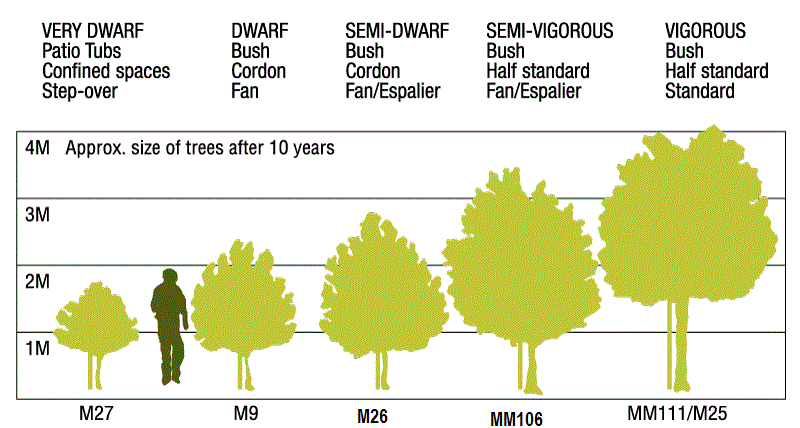
After taste, this is the next most important item. The rootstock controls how small or large, and how vigorous, your tree will be. Think about how many apple trees there are that have got out of control and fruit is left rotting on the ground because people can no longer manage them. In many cases, this is because people didn't consider the rootstock seriously, for both their current and future selves. Choose a fruit tree rootstock that you will be able to realistically maintain now and in the future. Types of rootstock with ultimate height if trained as a bush:

M27: very dwarfing, 1.2-1.8m (4-6ft) x 1.5m (5ft)
M9: dwarfing, 1.8-2.4m (6-8ft) x 2.7m (9ft)
M26: semi-dwarfing, 2.4-3m (8-10ft) x 3.6m (12ft)
MM106: semi-vigorous, 3-4m (10-13ft) x 4m (13ft)
MM111: semi-vigorous, 4-4.5 (13-15ft) x 4.5 (15ft)
M25: vigorous +4.5 (15ft) x 6m (20ft)

The RHS website goes into more detail about the growing habits of each of these rootstocks.

Useful graphic to show the approximate ultimate sizes of each rootstock. Source: Blackmoor

Climate
Apples grow best in temperate climates like the UK and northern Europe. Certainly, they aren't desert or rain forest plants. But within a temperate climate, some trees will grow better in certain conditions. So if you live in a particularly wet climate (hello west Wales), choosing trees that don't mind the wet makes sense. Also, some trees need more sun than others, like a nice south-facing wall (or north-facing if you're in the southern hemisphere), and what grows well in the south of England, for instance, won't necessarily in the north. Learn about your regional and local micro-climate conditions.

Cultivar
There are something line 750 different apple tree cultivars in the UK. Some will be incredibly niche, but there are probably a good 200 that are readily available from online fruit tree nurseries. There really will be one out there for every taste.

Pollination/flowering group
This refers to when the blossom will be out for insects to pollinate. Many apple trees are diploid, which means they need a least one other tree nearby in order to be pollinated. Of these, many will be  "self-sterile". This means their pollen won’t fertilize their own flowers and they therefore need another compatible cultivar for cross-pollination in order to produce fruit. And even the so-called "self-fertile" cultivars will fruit better with a partner tree.

Some apple trees are triploids, and they are different again. I'll quote here directly from the RHS:
... a few apple and pear cultivars (known as triploids) such as ‘Bramley’s Seedling’, ‘Holstein’, ‘Ribston Pippin’, ‘Blenheim Orange’ and ‘Catillac’ produce mainly sterile pollen. These won’t be any use for cross-pollinating other trees, and for their own fruit to set, still need other trees. Therefore if you grow a triploid cultivar you will also need two other trees that will pollinate each other as well as the triploid, and these three cultivars must all flower at the same time. (Source, RHS)
As far as I've seen in the UK, the pollination groups are either A - D, or flowering groups 1 - 7. A (1) will blossom first, then B (2), C (3) etc. They are essentially the same thing, just different naming/category conventions. The nursery's catalogue will tell you what pollination or flowering category a tree will have.

The key thing to know is that you should get two (or three for triploids) trees in either the same pollination/flowering group, or the adjacent pollination group. So:
  • Two A's or 1's of different cultivars/varieties will pollinate each other.
  • An A/1 and B/2 will pollinate each other, but and A/1 and C/3 will not.
  • A tree that is in the C/3 pollination group can be pollinated by other C/3 cultivars, but also B/2 and D/4 cultivars, etc.
  • However, you cannot only have two of the same cultivar in any pollination/flowering group, as these won't pollinate each other (these are self-sterile).
Trees should be planted within 18m (55ft) of each other to effectively cross pollinate.

Spur or tip bearing
Tip bearing: produce fruit at the tip of each shoot.
Spur bearing: produce fruit along side shoots (spurs)
Partial tip bearing: produce some spurs as well as fruit buds at some shoot tips.

Source: RHS Fruit and Vegetable Gardening, 2002, p. 175.

A majority of apples tend to be spur bearing, a few are both, but do check if it isn't stated clearly, as this will change the type of pruning you need to do to the tree. For example, if you go and prune all the tips of a tip bearing tree in winter, you will have just pruned off next seasons harvest.

Period of use
This is for how long are the apples, once ready for harvesting, able to store. Online nurseries often include this information. Some apples need to be eaten within a short space of time, whereas others may store for several months.

Fruit type
Culinary - cooking
Dessert - eating
Dual - both cooking and eating

Tree form or type
You will find a large number of tree types out there, but the most familiar ones will be: standard (your basic shaped apple tree), espalier, cordon, step-over, fan, and ballerina.

The most most common tree rootstock available will be a Maiden, which is an untrained one year old tree, probably about 1m high. You then train this into any of those above, dependent on it's rootstock, of course. This is the cheapest way to buy a tree, c. £15, but it will take longer before you will get your first harvest. If you can afford it, and don't want to wait, you could by a tree type listed above, already trained. A 1 or 2-tier espalier will probably be around £45, and you'll get your first harvest within a couple of years.

Right: a wonderful example of an espalier, at Anglesea Abbey. This is a pear; apples and pears have the same pruning regime.

Other thoughts
  • Grow something different to what is available in the supermarket. After all, you can already easily get those cultivars. Plus, it helps the species if a diverse range of apple trees grown.
  • Catalogues (print and online) should give you enough information about each cultivar available, often including the origin and history of a cultivar.
  • Pruning is done in winter for most apples.
  • If you only have a very small garden or balcony but would like a couple of different cultivars, there are some trees available, called 'family trees', that have grafted onto them two or three different cultivars of apple. In this case, one tree would cover your pollination/flowering needs too.
  • Pot grown apple trees (those that you purchased planted in pots) can be planted year round, though I'd avoid late spring and summer unless you want lots of work watering them daily.
  • Bare root trees (those you purchase which have no soil around them) are only available in Autumn and Winter and must be planted by the beginning of Spring. Planting during winter helps them establish their roots before the warmer weather starts. You will find a much, much, larger number of cultivars available as bare root trees.

Useful books and websites
The information here has aimed to just cover the key details that will help you choose an apple tree. For further reading, I refer to the following two books that I use the most:

RHS Fruit and Vegetable Gardening: this covers information on each the most common fruit and vegetables available, including good chapters on apples and other fruiting trees and bushes.

RHS Pruning and Training: this is my bible for learning how to prune your tree correctly. It has incredibly useful diagrams for many common ornamental and edible plants. Just it's chapter on Apple trees alone, is worth the cost. Though it's probably in your local library for free.

I find the best websites with the most useful information, are fruit tree nurseries. I have personally used and recommend: R.V. Roger, Walcot, Keepers, Orange Pippin and Blackmoor.

Recommended by others: Adam's Apples (by VP)

* * * * *
My hope is that this information will be useful to others. I've had to balance giving you enough key information, with not overwhelming you with too much information. If you think I've missed out a really key point, do leave a note in the comments.

Happy eating!

Saturday, 22 September 2012

First crop of Apple 'Charles Ross'

Very pleased with the first crop

I am very excited as today as I finally got my first crop off Apple 'Charles Ross'*. I first planted it as a 1-year old maiden in 2006, so it's been six years to get to the first crop. And yes, those of you who know apples will be thinking "it should have cropped before now". This is true, but I think because we moved in 2009, and I dug up the tree to bring it with me, it then needed time to settle in to it's new home at Gwenfar's Lottie.

Apple 'Charles Ross', 6 y.o. tree

I did actually get a couple of fruits growing on it last year, but they fell off before they were ready for picking.  As you can see from the photo of the tree above, the poor thing has taken on a bit of a lean to one side. Yes, I need to stake it! I should have done this before now, and the above is proof why staking is important.

I thinned the tree in June, when it had more fruit than the above photo, so I did something right... It clearly worked as the apples are a good medium-large size, as expected for this variety.

Fine specimen on the tree

Charles Ross is a dual purpose variety, so can be used for both eating and cooking. We have done an eating test and did enjoy it. It has a sweet-tart flavour and is a crunchy, solid apple. We concluded that you can eat it fresh, but thought it would taste even better cooked.

Inside the apple

So Kevin threw together a really simple dessert. Sliced apples (with skin), cooked in butter and golden syrup  until the apples are soft and the butter/syrup is bubbly, then serve. Add some cream to be extra decadent. The result - delish!

Kevin's golden apple dessert

Although a dual purpose apple, I suspect we will mainly use this as a cooking apple. It held together well when cooking, and its sweet-slightly-tart flavour makes an excellent dessert.

So, was it worth the 6-year wait? You bet!

*1-yr maiden, on M26 rootstock, purchased from Walcot Organic Nursery.