Showing posts with label Fruit trees. Show all posts

Sunday, 5 January 2020

Forest garden border: reviewing the first season

The L-shaped forest garden border along the south (left) and west (right) facing fences,
in July, prior to the new kitchen garden beds being created in front.

My forest garden border was first planted out in March this year, and I thought it would be useful to review it's first season. It's an awkward border to photograph on whole, so I tend to do it in sections, South (the left side) and West (the right side), which I'll use to refer to when discussing specific plants. A full plant list is at the bottom of this post.
The L-shaped forest garden border along the south (left) and west (right) facing fences,
with the just finished (in August) new kitchen garden beds in front.

I'm pretty pleased with the results from the first season. For a start, the blueberries already started producing, in particularly, Vaccinium corymbosum 'Hortblue Petite' on the South side. This was enough to add to several breakfast muselis.
First blueberry harvest

I had put up temporary netting to protect the fruits from the depredations of birds. However, this isn't an easy way to harvest, at least from an ME perspective, as it uses up more energy than you might expect trying to negotiate the netting and access the berries. So I need to make up a better long term netting set-up. I'm thinking of sewing my own netting cage together, I just need to work out the proportions, based on the size the blueberry bushes will eventually reach (about 1m square). A job for winter/spring.
Temporary netting around one of the young blueberry bushes

The Sorrel bulked up quickly and produced plenty of leaves throughout the season, which I have used in curries and other dishes. And the Rhubarb supplied a couple of kilos of fruit. We added manure around the crown at the end of the season, and will add more in Spring, to feed the hungry roots.

The comfrey has provided it's first harvest and I now have a bucket brewing (right) over winter that will give me comfrey tea, a homemade liquid fertiliser, to feed both edible and ornamental plants plants this coming season. Comfrey is rich in Nitrogen, which supports leafy growth, and Potassium, which promotes strong stem growth, flowering and fruiting of both edible and ornamental plants. I decided I didn't need two comfrey plants, so one has been dug up, and an apple tree has been planted in its place.

The apple trees were finally added at the end of November, after I chose and ordered three varieties at the October Apple Day that I attended. The trees that are all 4-5 years old, and there is a slight chance I might get fruit as early as next season. Fingers crossed.

The apple trees I chose were the following: Newton Wonder - double cordon (west-facing border)

Lord Lambourne (left) and Egremont Russet (right) - both single cordons (south-facing border)

A damson has been added to another part of the kitchen garden area. So not in the forest garden per se, but very close by (like, a couple of metres), so I thought it was worth a mention. I suspect it will be 2 or more years before I get any fruit off this tree. And I have planted some crocuses and daffidols in the border, so I get some early season pretty and the bees will have some food.

Overall, I feel like I've harvested quite a lot for the first season of my forest garden border. I'm not expecting to make any further changes to the planting and layout, so now all the plants can settle in and get growing for this coming and future seasons. And maybe, just maybe, I'll get a couple of apples next autumn?!

 Overview of the south-facing border in December.

Overview of the west-facing border in December

If you are interested in seeing how I planned the forest garden border, see my post creating a mini forest garden border.

* * * * *
Plant List
I've updated the plant list for the whole border, to include the recent additions.

Canopy layer
Apple trees: Malus Newton Wonder, Malus Lord Lambourne, Malus Egremont Russet
Prunus domestica 'Golden Transparent' (greengage)

Just outside of the Forest Garden border are also:
Amelanchier x grandiflora 'Ballerina' and Prunus insititia 'Shropshire Damson'

Shrub layer
Azalea (variety unknown)
Cranberry (variety unknown)
Vaccinium corymbosum 'Bluecrop' (blueberry)
Vaccinium corymbosum 'Hortblue Petite' (blueberry)

Perennial layer - edible
Akebia quinata
Foeniculum vulgare 'Purpureum'
Origanum vulgare 'Aureum' (golden oregano)
Rhubarb (variety unknown)
Rumex acetosa (non-flowering sorrel)
Symphytum x uplandicum 'Bocking 14' (comfrey)

Perennial layer - ornamental
Knautia macedonica
Lychnis coronaria Atrosanguinea Group
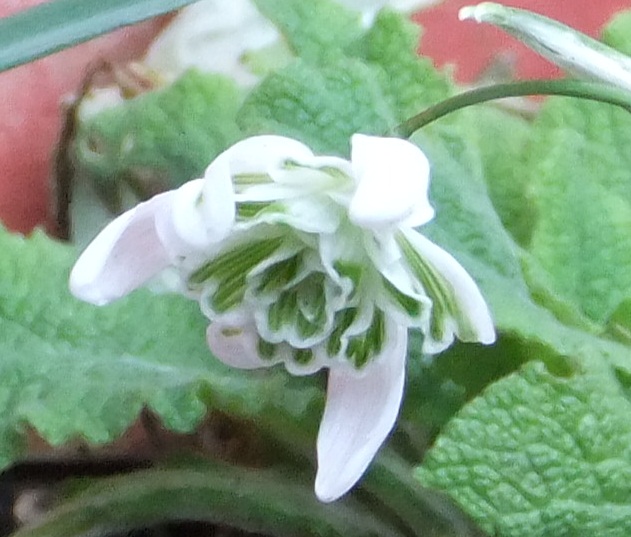
Omphalodes cappadocica 'Cherry Ingram' (ornamental)

Ground cover (plants mixed all around the border)
Ajuga reptans 'atropurpurea'
Allium ursinum (wild garlic/ramsons)
Armeria pseudarmeria 'Ballerina Lilac'
Crocus Etruscus Zwanenburg
Crocus Orange Monarch
Crocus Sieberi Spring Beauty
Cyclamen hederifolium
Fragaria x ananassa 'Samba' (strawberry)
Galanthus 'Ophelia'
Narcissus Brackenhurst
Narcissus Minnow
Narcissus Mother Duck
Narcissus Rijnvelds Early Sensation
Phacelia tanacetifolia
Primula vulgaris
Pulmonaria 'Blue Ensign'
Viola odorata 'Queen Charlotte'

Monday, 30 September 2019

Tips to help you choose the right apple tree(s)

Malus domestica 'Charles Ross'

In the last couple of weeks I've been carefully researching what apple trees that I want to plant in my Forest Garden Border. One thing I found was that it was hard to find all the key information that informs your choice, in one place, whether online or in books. Since this is all in my head at the moment, I thought I'd jot down the key tips I felt would be useful for anyone wanting to grow apple trees.

Disclaimer: as I'm based in the UK, this is where my learning and knowledge is based, and this will be reflected below. I am an amateur, so this shouldn't be viewed as expert advice. This is just a collation of the information I found, which I thought others might find useful.

* * * * *
Taste 
This is of course number one. If you don't like the fruit, you won't eat it. So choosing for taste is paramount. In the UK at least, fruit tree nurseries and community groups often hold Apple Days in October, and usually have a range of cultivars available for you to taste.

Rootstock
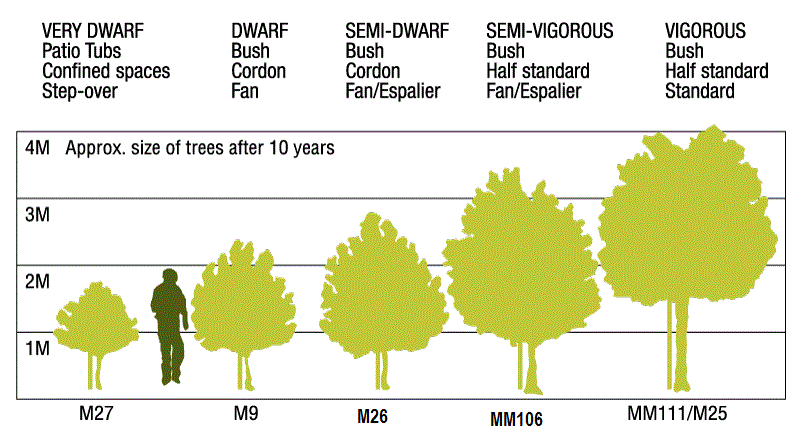
After taste, this is the next most important item. The rootstock controls how small or large, and how vigorous, your tree will be. Think about how many apple trees there are that have got out of control and fruit is left rotting on the ground because people can no longer manage them. In many cases, this is because people didn't consider the rootstock seriously, for both their current and future selves. Choose a fruit tree rootstock that you will be able to realistically maintain now and in the future. Types of rootstock with ultimate height if trained as a bush:

M27: very dwarfing, 1.2-1.8m (4-6ft) x 1.5m (5ft)
M9: dwarfing, 1.8-2.4m (6-8ft) x 2.7m (9ft)
M26: semi-dwarfing, 2.4-3m (8-10ft) x 3.6m (12ft)
MM106: semi-vigorous, 3-4m (10-13ft) x 4m (13ft)
MM111: semi-vigorous, 4-4.5 (13-15ft) x 4.5 (15ft)
M25: vigorous +4.5 (15ft) x 6m (20ft)

The RHS website goes into more detail about the growing habits of each of these rootstocks.

Useful graphic to show the approximate ultimate sizes of each rootstock. Source: Blackmoor

Climate
Apples grow best in temperate climates like the UK and northern Europe. Certainly, they aren't desert or rain forest plants. But within a temperate climate, some trees will grow better in certain conditions. So if you live in a particularly wet climate (hello west Wales), choosing trees that don't mind the wet makes sense. Also, some trees need more sun than others, like a nice south-facing wall (or north-facing if you're in the southern hemisphere), and what grows well in the south of England, for instance, won't necessarily in the north. Learn about your regional and local micro-climate conditions.

Cultivar
There are something line 750 different apple tree cultivars in the UK. Some will be incredibly niche, but there are probably a good 200 that are readily available from online fruit tree nurseries. There really will be one out there for every taste.

Pollination/flowering group
This refers to when the blossom will be out for insects to pollinate. Many apple trees are diploid, which means they need a least one other tree nearby in order to be pollinated. Of these, many will be  "self-sterile". This means their pollen won’t fertilize their own flowers and they therefore need another compatible cultivar for cross-pollination in order to produce fruit. And even the so-called "self-fertile" cultivars will fruit better with a partner tree.

Some apple trees are triploids, and they are different again. I'll quote here directly from the RHS:
... a few apple and pear cultivars (known as triploids) such as ‘Bramley’s Seedling’, ‘Holstein’, ‘Ribston Pippin’, ‘Blenheim Orange’ and ‘Catillac’ produce mainly sterile pollen. These won’t be any use for cross-pollinating other trees, and for their own fruit to set, still need other trees. Therefore if you grow a triploid cultivar you will also need two other trees that will pollinate each other as well as the triploid, and these three cultivars must all flower at the same time. (Source, RHS)
As far as I've seen in the UK, the pollination groups are either A - D, or flowering groups 1 - 7. A (1) will blossom first, then B (2), C (3) etc. They are essentially the same thing, just different naming/category conventions. The nursery's catalogue will tell you what pollination or flowering category a tree will have.

The key thing to know is that you should get two (or three for triploids) trees in either the same pollination/flowering group, or the adjacent pollination group. So:
  • Two A's or 1's of different cultivars/varieties will pollinate each other.
  • An A/1 and B/2 will pollinate each other, but and A/1 and C/3 will not.
  • A tree that is in the C/3 pollination group can be pollinated by other C/3 cultivars, but also B/2 and D/4 cultivars, etc.
  • However, you cannot only have two of the same cultivar in any pollination/flowering group, as these won't pollinate each other (these are self-sterile).
Trees should be planted within 18m (55ft) of each other to effectively cross pollinate.

Spur or tip bearing
Tip bearing: produce fruit at the tip of each shoot.
Spur bearing: produce fruit along side shoots (spurs)
Partial tip bearing: produce some spurs as well as fruit buds at some shoot tips.

Source: RHS Fruit and Vegetable Gardening, 2002, p. 175.

A majority of apples tend to be spur bearing, a few are both, but do check if it isn't stated clearly, as this will change the type of pruning you need to do to the tree. For example, if you go and prune all the tips of a tip bearing tree in winter, you will have just pruned off next seasons harvest.

Period of use
This is for how long are the apples, once ready for harvesting, able to store. Online nurseries often include this information. Some apples need to be eaten within a short space of time, whereas others may store for several months.

Fruit type
Culinary - cooking
Dessert - eating
Dual - both cooking and eating

Tree form or type
You will find a large number of tree types out there, but the most familiar ones will be: standard (your basic shaped apple tree), espalier, cordon, step-over, fan, and ballerina.

The most most common tree rootstock available will be a Maiden, which is an untrained one year old tree, probably about 1m high. You then train this into any of those above, dependent on it's rootstock, of course. This is the cheapest way to buy a tree, c. £15, but it will take longer before you will get your first harvest. If you can afford it, and don't want to wait, you could by a tree type listed above, already trained. A 1 or 2-tier espalier will probably be around £45, and you'll get your first harvest within a couple of years.

Right: a wonderful example of an espalier, at Anglesea Abbey. This is a pear; apples and pears have the same pruning regime.

Other thoughts
  • Grow something different to what is available in the supermarket. After all, you can already easily get those cultivars. Plus, it helps the species if a diverse range of apple trees grown.
  • Catalogues (print and online) should give you enough information about each cultivar available, often including the origin and history of a cultivar.
  • Pruning is done in winter for most apples.
  • If you only have a very small garden or balcony but would like a couple of different cultivars, there are some trees available, called 'family trees', that have grafted onto them two or three different cultivars of apple. In this case, one tree would cover your pollination/flowering needs too.
  • Pot grown apple trees (those that you purchased planted in pots) can be planted year round, though I'd avoid late spring and summer unless you want lots of work watering them daily.
  • Bare root trees (those you purchase which have no soil around them) are only available in Autumn and Winter and must be planted by the beginning of Spring. Planting during winter helps them establish their roots before the warmer weather starts. You will find a much, much, larger number of cultivars available as bare root trees.

Useful books and websites
The information here has aimed to just cover the key details that will help you choose an apple tree. For further reading, I refer to the following two books that I use the most:

RHS Fruit and Vegetable Gardening: this covers information on each the most common fruit and vegetables available, including good chapters on apples and other fruiting trees and bushes.

RHS Pruning and Training: this is my bible for learning how to prune your tree correctly. It has incredibly useful diagrams for many common ornamental and edible plants. Just it's chapter on Apple trees alone, is worth the cost. Though it's probably in your local library for free.

I find the best websites with the most useful information, are fruit tree nurseries. I have personally used and recommend: R.V. Roger, Walcot, Keepers, Orange Pippin and Blackmoor.

Recommended by others: Adam's Apples (by VP)

* * * * *
My hope is that this information will be useful to others. I've had to balance giving you enough key information, with not overwhelming you with too much information. If you think I've missed out a really key point, do leave a note in the comments.

Happy eating!

Saturday, 5 May 2018

The case of the strange straight apple tree in the garden


This is a rather strange apple tree. I know it's an apple tree, because it had a couple of apples on it when we viewed the house we now live in, last November. Unless the sellers managed to glue a couple to the tree for effect.

Anyway, I'm not sure what to do about it. I mean, it's growing straight up.

Of course, in general, things grow up, unless they grow in the ground, but let's not confuse this matter any further. But for not just the trunk, but all the branches to grow up in the same manner, I mean, how do you even get an apple tree to grow in such a way?

There is of course the issue of taste. And going by these buds, and the luck of the weather goddess, it looks like I should get some apples this year. What type, cookers or eaters, well, I guess I'll have to wait and see. And hope I can get to an apple day with some of the fruit to see if I can find out what variety it is.

However, going back to the issue of straightness, I'm in a quandary. What do I do with this tree? How in the hell do I prune it so the branches go out and not straight up. I'm asking you, dear reader, for help! Any suggestions? And can I start pruning now, or wait until next winter?

Over to you.


Monday, 18 July 2016

Netting the cherries (aka me vs the blackbirds)


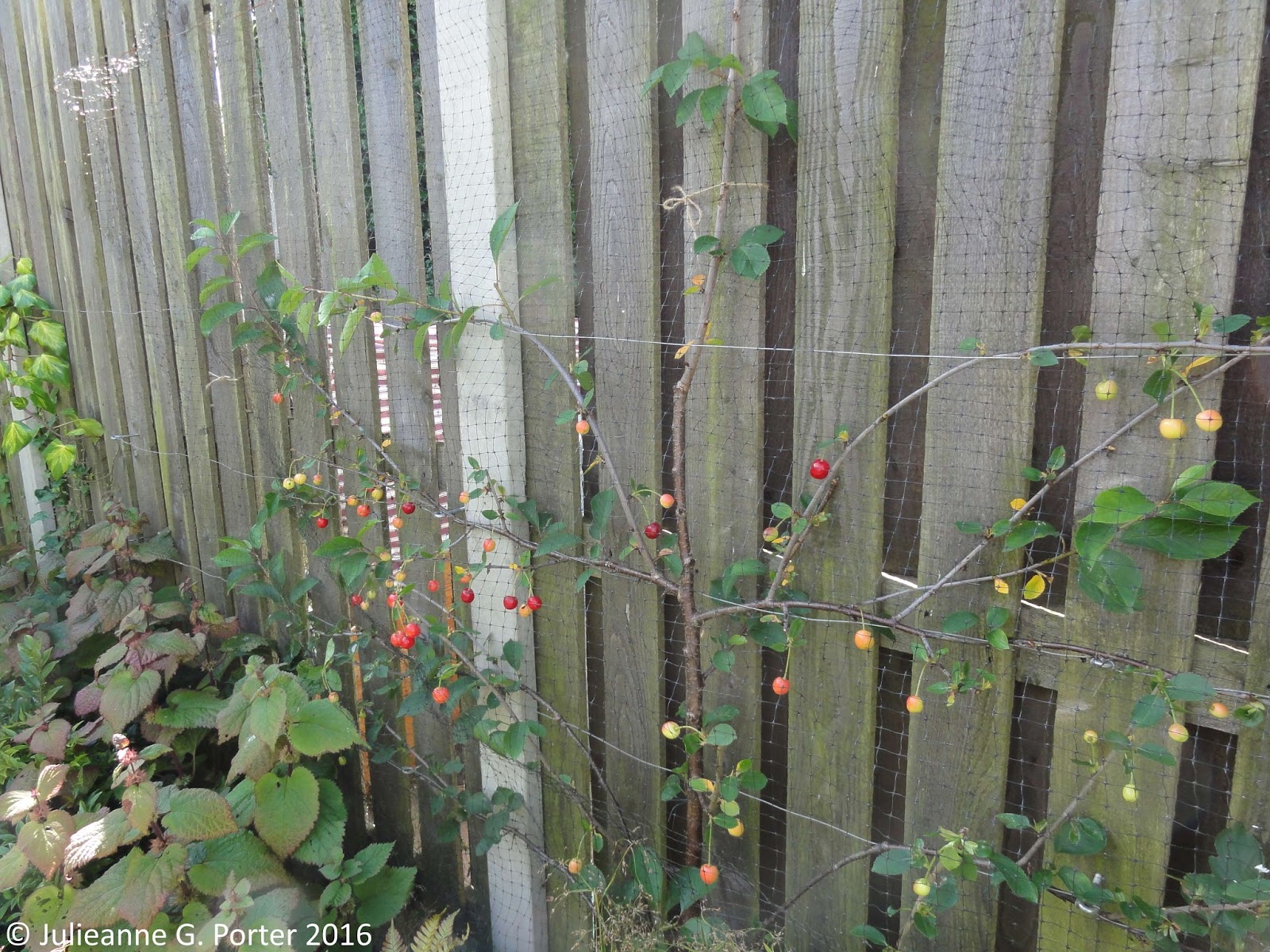
This year I have my first proper crop fruiting on my Morello (sour) cherry, Prunus cerasus 'Morello'. I know from previous experience from when I lived in Oxford, that blackbirds are rather partial to Morello cherries. In fact, they seem to know the exact second they are ready to eat. I lost a large crop to them and learned that in future I would net my cherries as they were turning red, if I wanted to beat the blackbirds to them.

As you can see, the fruit on my young (c. 4.5 years old) tree are turning red!

I'm sure the other day I saw a Blackbird eyeing off my cherry tree. That prompted me to action. That ball of mesh that I've been meaning to sort out for like 2 years, might just come in handy. So I lay it out on the ground and held it down with heavy pots so I could straighten it out. I then measured it. 2m x 2m - perfect. Using some string, I tied it to the slatted fencing, with the end result thus:


My cherries are now protected. I've assumed that blackbirds, being large birds, wouldn't be able to cling onto the thin mesh to peck at the cherries.


Let's hope that assumption is right(!), and that netting the cherries in time means I get to make Morello Cherry jam this year.


Ok, a small jar of jam...


Fingers crossed I've outwitted the blackbirds.

Tuesday, 12 July 2016

Quince watch 2016: July update


And then there were nine...

There have been some developments since the May Quince watch update. The late May flowering has indeed resulted in some quincelets! Oh, the excitement.

There were ten, until one fell off the tree today. Ugh.

So now there are nine.

Here's one:

Here's another:

Oh the excitement, another!

Ok, I won't show you a picture of all nine. Nine quincelets. I felt a few of them up (ooh err) and they appeared to be firmly attached. Well, apart from the one that wasn't. So there is some hope here that a few might develop from quincelets to quinces.

In fact, a sudden late flowering, well a late flowering consisting of one flower, might take me up to ten quincelets again...

The blurriness of the photo is deliberate (of course) to represent the shaky foundation upon which all my quincelet hopes rest.


The tree has also put on a considerable burst in growth which is also nice to see. Coz potential for even more quinces next year. I've given it a summer prune to take out any branches that were crossing and causing it to be a bit congested. That should help it get more light and air and produce healthier fruit.


So, nine, maybe ten, quincelets. I'm dreaming of Quince jelly. Cautiously.


* * * * *
I am growing Cydonia oblonga 'Serbian Gold', also known as 'Leskovac'. My tree is about 6 years old.

Sunday, 29 May 2016

Quince watch 2016: May


Is this the year when I will finally have my first, edible fruits, from my Quince tree? Now that it has finally flowered, Quince watch has officially begun.


My Cydonia oblonga 'Serbian' (also known as 'Leskovac') is now about 6 years old. Last year it managed one solid hard golf-ball sized fruit. When I say solid, I mean granite solid. It was solid.


Like Alison over at The Blackberry Garden, I have hopes for non-solid fruit this year. Even, dare I suggest it, edible (jam-ible) fruit?

Is this a potential quincelet?


I live in hope. And with a watchful eye.

Thursday, 16 January 2014

Plant memories

Plants can contain memories. That is, beyond the memories within their genetic make up, they have memories tied up within them that can be deeply personal to the grower planting them.

Some plants contain the memory of place from where they came. Galanthus Bagpuize Virginia, of which I recently planted bulbs in my new Sheffield garden, is a reminder of visits to Kingston Bagpuize Garden in West Oxfordshire. At one point I lived in Witney, which was only a few miles away from the garden, and even when we moved back to Oxford, it was close enough that it became an almost semi-annual pilgrimage at the end of each winter. The garden at Kingston Bagpuize contains carpets of snowdrops, aconites and crocuses and are a welcome delight as winter and the long dark days are coming to an end, and our hopes for Spring and a new growing season are ignited. As snowdrops like to hybridise, Kingston Bagpuize ended up with it's own variety of Galanthus.

Galanthus Bagpuize Virginia

On one visit a few years ago I wished to purchase some for my own garden (back when we lived in Oxford); sadly none were available on the plant stall. But joy! The owner was happy to dig some up for me and I was able to take some home. They did well in the area of my Oxford garden in which they had been planted, and fortunately they came up before we moved to Sheffield last March, even through the heavy snow, so I dug up a batch to move with me. I now am awaiting with bated breath to see if I will at least get the leaves of Galanthus Bagpuize Virginia come up this year. Snowdrops can take a couple of years to settle in, so I'm not expecting flowers this year, but based on previous experience if I get the leaves this year, then all should bode well for a new flowering of this lovely reminder of a plant and place from where it comes.

This plant contains memories not just of the regular and highly enjoyable garden visits, but also of the generous gardener who happily shared her snowdrops with me (gardeners are the most generous people!), as well as of some lovely Oxon friends such as Kate Griffin and J-P, who joined me in visiting the garden.


Plants can, of course, remind us of people. I'm rather fond of receiving garden gift vouchers as they allow me the opportunity to purchase some much sought-after plants. My friend Kate Kilpatrick gave me some vouchers as a 40th birthday gift (2007). I had also been given a much-coveted arch (see left, picture from my Oxford garden) by my partner Kevin and his mother Audrey, also for my 40th birthday, and it was wanting a climber to to take advantage of it's height. When Kate gave me the vouchers, I knew exactly what I wanted.

Back in 2006, at a visit to Chelsea Flower Show (the NZ garden), I came across climber/rambler Rosa Seagull. It was beautifully fragrant and stopped me in my tracks. After a chat to the designer of the garden who relayed that it was trouble free and didn't have much problem with black spot, I decided I had finally found a rose for me.

Thanks to Kate's gift I was able to purchase the rose climber I wanted to go up the arch that I loved. Serendipity. Rosa Seagull flowers quite profusely and usually flowers early summer and then a second time late summer/early autumn. I realise I don't have a photograph of it in flower up my arch, I think because the fragrance so takes me away I forget to get out the camera! Each time it flowers, I am reminded of my friend Kate, whose gift made it possible, and it makes me smile and drink it in.

Rosa Seagull at Chelsea Flower Show, May 2006

The arch and Rosa Seagull has moved with me, first from Witney to Oxford and then last year to our current home in Sheffield. The arch and the rose is looking good. I'll be remembering Kate again this summer.

I have many other plants in my garden that contain memories. Like a cutting of a cutting of the first plant I brought when I moved to the UK, a St John's Wort. I see it's yellow flowers and am immediately reminded of chasing bumblebees around the gardens at Lanhydrock in Cornwall. It was mid-Spring, and Kevin and I were over-excited to see so many bumblebees; we don't have them (or at least didn't when we were growing up) in Australia, and had only ever seen cartoon pictures of them, and here they were in real life! Many of them were on the bright yellow St John's Wort flowers and it prompted me to purchase my first plant. It was just the beginning my my plant and gardening addiction.

Fritillaria Meleagris, Iffley Meadows, Oxford

And there are other memories, such as Pulmonaria Blue Ensign that I first saw at Beth Chatto's garden one Spring, visiting with Audrey. The deep blue flowers shone surprisingly brightly in the woodland garden. Here I learnt the delights that a shady garden can give you, that 'full-sun' wasn't the be-all and end-all of plant growing. And I've recent planted many bulbs of Fritillaria Meleagris, Oxfordshire's county flower, delicate and refined, and reminding me of many a visit to Iffley Meadows to enjoy the sea of snakes heads as far as the eye could see.

With our move from Oxford to Sheffield, plants, people, places and gift vouchers came together in what I hope will be, a most fruitful way.

Upon leaving both jobs and Oxford, I was given quite a few garden gift vouchers. Lucky me! My new garden was smaller and almost a blank canvas and I decided that if I was going to have trees it in, I wanted them to have a food producing yield, alongside their environmental and ascetic qualities. I knew exactly which fruit trees I wanted. Below is a photograph of my newly planted beauties and a description of the people and places contained within the memory of each one.

 
Prunus domestica 'Denniston's Superb' Greengage
A memory of my colleagues at Low Carbon Hub and the Dower House Garden

I first came across Greengage jam when visiting the Dower House Garden in August 2010. Taking a tea break we were offered scones by the garden maker and author of The Morville Hours, Katharine Swift. On offer to accompany the scones was a variety of homemade jams, including greengage jam. I had only recently discovered and was in love with damson jam, so I thought it would be fun to try another new jam. Woah! It was incredible and I was utterly hooked. I knew immediately I wanted to be able to grow a greengage and make my own jam one day. I finally planted that dream thanks to vouchers from my colleagues at Low Carbon Hub, where I finished as book-keeper not long before leaving Oxford. I loved working at the Hub and my new tree will be a memory of them and the inspiring work they do working towards a low carbon future across Oxfordshire.

Prunus insititia 'Shropshire Damson' (Shropshire prune)
A memory of  Dr Audrey Meaney

As mentioned above, I discovered damson jam not long before discovering greengage jam. Oddly, I cannot recall where I first tasted damson jam, but I did plant a tree, the same variety, Shropshire Prune, in my Oxford garden. And when I got my first crop, well.... I didn't make jam. Turns out the damsons didn't get more than foot from the tree before they were in my mouth. I recall squealing in delight at the flavour and yelling out to Kevin to come and try some before I ate them all. He did get a couple... The tree was nicely established by the time we were leaving Oxford so I decided, sadly, that I shouldn't dig it up and move it. Thankfully, Audrey came to the rescue and gave me vouchers for my 2012 birthday, and voila, they turned into a new damson tree in my Sheffield garden. Magic.

Prunus cerasus 'Crown Morello'
A memory of Margaret Walker and Witney Fair trade campaigners

Morello Cherry makes me think of blackbirds. Naughty naughty blackbirds that stole my crop last year. The little buggers would pick the cherries from the tree then sit on the paved brick area in front of my kitchen window and poke their beaks at me before downing my cherries. I'd run out to chase them off but they had stripped the tree in no time. Netting. Netting is very important - I know that now.

I'm not particularly interested in normal cherries (sweet ones) so when I inherited the tree in my Oxford garden from the previous owners, I hadn't thought about collecting the fruit. My friend Jackie did (this was the year before the blackbirds discovered the tree), and took away the whole crop, returning a couple of weeks later with a jar of sour cherry jam for me to try. Bloody hell - I gave away all those cherries - what an idiot! Because of course, Morello cherry jam is divine. Another fruit tree I decided was a must have in my new garden.

And you guessed it, more garden vouchers. I campaigned with Margaret Walker and many others for several years in order to make Witney a Fair Trade town. After several hard years of campaigning, running an annual fair trade market etc, we finally succeeded a couple of years after I left Witney, in 2011. Margaret and I also campaign together with Oxford WDM. Some how the deep red cherries of the Morello tree suit a memory of someone involve in social and economic justice campaigns, being, you know, red!

Cydonia oblonga 'Serbian', Quince
A memory of my colleagues & the community at Barracks Lane Community Garden

My final set of vouchers gave me the gift of a Quince tree. I was the Garden Coordinator at Barracks Lane Community Garden in Oxford from March 2010 to July 2012. It was a busy and varied role, doing everything from organising 'local food' events and running gardening workshops, to taking bookings and answering questions about the history of the garden. The space the garden now inhabits was transformed by the efforts of many local people, from a dangerous toxic waste-filled old garage site into a beautiful garden space that is used by the whole community. Amongst many of the plants flowering where there was once dirty car oil and used syringes, was a quince tree.

I don't think I'd even seen a quince tree before I became involved with the garden. The flowers have a lovely fragrance and the fruit produced are golden balls of sunshine. One of the Trustees, Annie Davy, decided one harvest festival that the fruit was ripe and made quince jelly from the fruit. And yes, I hadn't had quince jelly before. There is a theme here isn't there?! One mouthful of Annie's quince jelly and you guessed it, I had to have my own quince tree!

I had intended on obtaining a quince tree that autumn, but life changed and we decided to move to Sheffield, so I held off using the vouchers until recently. Now I have my young quince tree. As you can see from above, it's already catching the afternoon light of the winter sun. This is fitting as when I think of Barracks Lane Garden, I think of light, as well as laughter, and a community of wonderful kind people whose efforts have made an amazing difference.

* * * * *

For me, plants can contain memories of people and places, of my history and where it touches with theirs. Their fragrance, their flowers, their leaves, their fruit, evoke memories of many kind, interesting and caring people, as well as of places that have delighted and given inspiration. The memories of all will continue to grow in the plants of my small Sheffield garden. Thank you all, for your gifts.