Malus domestica 'Charles Ross'
In the last couple of weeks I've been carefully researching what apple trees that I want to plant in my Forest Garden Border. One thing I found was that it was hard to find all the key information that informs your choice, in one place, whether online or in books. Since this is all in my head at the moment, I thought I'd jot down the key tips I felt would be useful for anyone wanting to grow apple trees.
Disclaimer: as I'm based in the UK, this is where my learning and knowledge is based, and this will be reflected below. I am an amateur, so this shouldn't be viewed as expert advice. This is just a collation of the information I found, which I thought others might find useful.
* * * * *
Taste
This is of course number one. If you don't like the fruit, you won't eat it. So choosing for taste is paramount. In the UK at least, fruit tree nurseries and community groups often hold Apple Days in October, and usually have a range of cultivars available for you to taste.
Rootstock
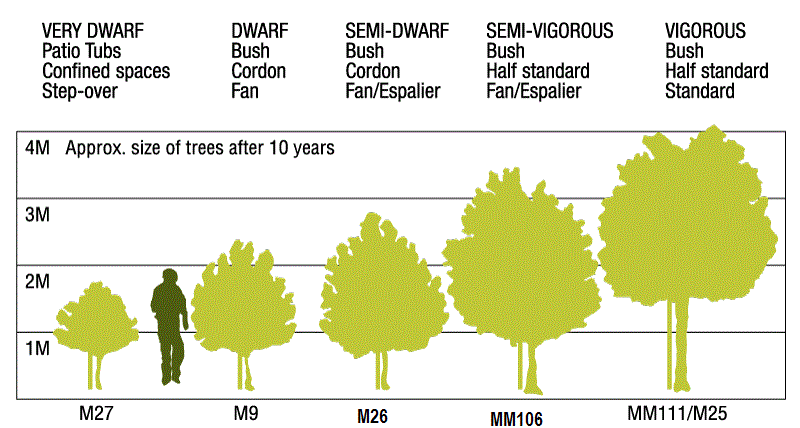
After taste, this is the next most important item. The rootstock controls how small or large, and how vigorous, your tree will be. Think about how many apple trees there are that have got out of control and fruit is left rotting on the ground because people can no longer manage them. In many cases, this is because people didn't consider the rootstock seriously, for both their current and future selves. Choose a fruit tree rootstock that you will be able to realistically maintain now and in the future. Types of rootstock with ultimate height if trained as a bush:
M27: very dwarfing, 1.2-1.8m (4-6ft) x 1.5m (5ft)
M9: dwarfing, 1.8-2.4m (6-8ft) x 2.7m (9ft)
M26: semi-dwarfing, 2.4-3m (8-10ft) x 3.6m (12ft)
MM106: semi-vigorous, 3-4m (10-13ft) x 4m (13ft)
MM111: semi-vigorous, 4-4.5 (13-15ft) x 4.5 (15ft)
M25: vigorous +4.5 (15ft) x 6m (20ft)
The
RHS website goes into more detail about the growing habits of each of these rootstocks.
Useful graphic to show the approximate ultimate sizes of each rootstock. Source:
Blackmoor
Apples grow best in temperate climates like the UK and northern Europe. Certainly, they aren't desert or rain forest plants. But within a temperate climate, some trees will grow better in certain conditions. So if you live in a particularly wet climate (hello west Wales), choosing trees that don't mind the wet makes sense. Also, some trees need more sun than others, like a nice south-facing wall (or north-facing if you're in the southern hemisphere), and what grows well in the south of England, for instance, won't necessarily in the north. Learn about your regional and local micro-climate conditions.
Cultivar
There are something line 750 different apple tree cultivars in the UK. Some will be incredibly niche, but there are probably a good 200 that are readily available from online fruit tree nurseries. There really will be one out there for every taste.
Pollination/flowering group
This refers to when the blossom will be out for insects to pollinate. Many apple trees are diploid, which means they need a least one other tree nearby in order to be pollinated. Of these, many will be
"self-sterile". This means their pollen won’t fertilize their own
flowers and they therefore need another compatible cultivar for
cross-pollination in order to produce fruit. And even the so-called "self-fertile" cultivars will fruit better with a partner tree.
Some apple trees are triploids, and they are different again. I'll quote here directly from the RHS:
... a few apple and pear cultivars (known as
triploids) such as ‘Bramley’s Seedling’, ‘Holstein’, ‘Ribston Pippin’,
‘Blenheim Orange’ and ‘Catillac’ produce mainly sterile pollen. These
won’t be any use for cross-pollinating other trees, and for their own
fruit to set, still need other trees. Therefore if you grow a triploid
cultivar you will also need two other trees that will pollinate each
other as well as the triploid, and these three cultivars must all flower
at the same time. (Source, RHS)
As far as I've seen in the UK, the pollination groups are either A - D, or flowering groups 1 - 7. A (1) will blossom first, then B (2), C (3) etc. They are essentially the same thing, just different naming/category conventions. The nursery's catalogue will tell you what pollination or flowering category a tree will have.
The key thing to know is that you should get two (or three for triploids) trees in
either the same pollination/flowering group, or the adjacent pollination group. So:
- Two A's or 1's of different cultivars/varieties will pollinate each other.
- An A/1 and B/2 will pollinate each other, but and A/1 and C/3 will not.
- A tree that is in the C/3 pollination group can be pollinated by other C/3 cultivars, but also B/2 and D/4 cultivars, etc.
- However, you cannot only have two of the same cultivar in any pollination/flowering group, as these won't pollinate each other (these are self-sterile).
Trees should be planted within 18m (55ft) of each other to effectively cross pollinate.
Spur or tip bearing
Tip bearing: produce fruit at the tip of each shoot.
Spur bearing: produce fruit along side shoots (spurs)
Partial tip bearing: produce some spurs as well as fruit buds at some shoot tips.
Source: RHS Fruit and Vegetable Gardening, 2002, p. 175.
A majority of apples tend to be spur bearing, a few are both, but do check if it isn't stated clearly, as this will change the type of pruning you need to do to the tree. For example, if you go and prune all the tips of a tip bearing tree in winter, you will have just pruned off next seasons harvest.
Period of use
This is for how long are the apples, once ready for harvesting, able to store. Online nurseries often include this information. Some apples need to be eaten within a short space of time, whereas others may store for several months.
Fruit type
Culinary - cooking
Dessert - eating
Dual - both cooking and eating
Tree form or type

You will find a large number of tree types out there, but the most familiar ones will be: standard (your basic shaped apple tree), espalier, cordon, step-over, fan, and ballerina.
The most most common tree rootstock available will be a Maiden, which is an untrained one year old tree, probably about 1m high. You then train this into any of those above, dependent on it's rootstock, of course. This is the cheapest way to buy a tree, c. £15, but it will take longer before you will get your first harvest. If you can afford it, and don't want to wait, you could by a tree type listed above, already trained. A 1 or 2-tier espalier will probably be around £45, and you'll get your first harvest within a couple of years.
Right: a wonderful example of an espalier, at Anglesea Abbey. This is a pear; apples and pears have the same pruning regime.
Other thoughts
- Grow something different to what is available in the supermarket. After all, you can already easily get those cultivars. Plus, it helps the species if a diverse range of apple trees grown.
- Catalogues (print and online) should give you enough information about each cultivar available, often including the origin and history of a cultivar.
- Pruning is done in winter for most apples.
- If you only have a very small garden or balcony but would like a couple of different cultivars, there are some trees available, called 'family trees', that have grafted onto them two or three different cultivars of apple. In this case, one tree would cover your pollination/flowering needs too.
- Pot grown apple trees (those that you purchased planted in pots) can be planted year round, though I'd avoid late spring and summer unless you want lots of work watering them daily.
- Bare root trees (those you purchase which have no soil around them) are only available in Autumn and Winter and must be planted by the beginning of Spring. Planting during winter helps them establish their roots before the warmer weather starts. You will find a much, much, larger number of cultivars available as bare root trees.
Useful books and websites
The information here has aimed to just cover the key details that will help you choose an apple tree. For further reading, I refer to the following two books that I use the most:
RHS Fruit and Vegetable Gardening: this covers information on each the most common fruit and vegetables available, including good chapters on apples and other fruiting trees and bushes.
RHS Pruning and Training: this is my bible for learning how to prune your tree correctly. It has incredibly useful diagrams for many common ornamental and edible plants. Just it's chapter on Apple trees alone, is worth the cost. Though it's probably in your local library for free.
I find the best websites with the most useful information, are fruit tree nurseries. I have personally used and recommend:
R.V. Roger,
Walcot,
Keepers,
Orange Pippin and
Blackmoor.
Recommended by others:
Adam's Apples (by
VP)
* * * * *
My hope is that this information will be useful to others. I've had to balance giving you enough key information, with not overwhelming you with too much information. If you think I've missed out a really key point, do leave a note in the comments.
Happy eating!