Showing posts with label MECFS. Show all posts

Friday, 1 March 2019

Creating a mini forest garden border

For some years I've been enamoured of the idea to create a forest garden, an edible and fairly low maintenance way to grow food. It's only with this garden that I realised that I had the right conditions to finally create my own mini forest garden border.

Martin Crawford's book (right) is the seminal text for learning about forest gardening, and it was a rare occasion where I read a gardening book from cover to cover. It just has so much information that was written in a straight forward tone, following each step of the process, and offering a large range of suggestions of what plants can be grown in each layer that will suit a range of climates.

My intention here is to show you how you can use the principles of creating a forest garden on a small urban garden scale. I aim to create a space that offers food for myself and for pollinators, that works within my health limitations (I have the chronic illness, ME), and that adds beauty to my small garden, whilst also being low maintenance.

The space that will become my Forest Garden Border

First up, I measured out the space and plotted this onto a base map, including the direction of North. I had previously done a soil test so I knew that my soil is acid clay. Apart from digging the holes for plants, I use the no-dig method. I plan on adding compost and mulch each time a key plant is planted, and will continue to add some each autumn to the whole border and I'll let the worms do the work to loosen up the soil, and release the nutrients that are locked up in clay soil.

I had spent a few months surveying the space and the way light and shadow moved across it and added a sun map on top of the base map. The border has one south-facing side and one west facing side and the arrows show how the sun moves across the garden during the day, moving from the top arrow, down. Plotting this and the base may measurements out was important for helping me decide how many trees, and what type, I could include in my design.

For example, the Amelanchier, which is shown on the Sun Map, is in a raised border off to the right. Though it will cast a small amount of shade a certain times of day when in leaf, because of it's height, and the height of the sun from April to September, this will be quite minimal and won't impact on the amount of light plants like the rhubarb and apple trees will get. And in winter it's deciduous so the forest garden border will benefit from all light available during this period. The greengage is in the South-West corner, and won't be casting an shade at all on the plants below as the sun is always moving in front of it. I do need to ensure I keep it pruned so that it doesn't get to big and block a neighbour's garden though.

Now we come to the layout map. Here I have plotted out all the key plants, A - N, and worked out their ultimate size and placed each onto the map. The ground cover plants will be slotted in here and there as space allows.
See the full list of plants below

Drawing circles is not my strong point(!). But I've been able to map out the maximum size of each plant so I'm clear what can fit in. It will still look a little bare for the first couple of years whilst the plants start filling out, so I'll have to be strong and not add any more, only to have to remove them later because the other plants have grown to their full width and height.

A forest garden has 3 layers, though I've broken them down below into 4 (separating out the Perennial and Ground Cover layers), as I found this more helpful for my planning.

Tree canopy layer: This includes small as well as large trees. These are A, H and N on my plan, a greengage and two apple trees.There is also the Amlanchier tree off to the right of the actual border, that I consider a part of my forest garden. Whilst it looks like they will be crowding the plants next to them, they won't because they will all have trunks with the first branches growing above the plants below in the Shrub and Perennial layers.

Shrub layer: Because my soil is acid clay, it made sense to add in fruit that grows well in acid soil. So cranberry and blueberries have been chosen. One of the blueberry varieties, Hortblue Petite, crops at least twice a year, and it is a nectar source for bees and other beneficial insects.

Perennial layer: This is going to be a mix of edible plants, such as the sorrel and rhubarb, and plants for pollinators, such as the comfrey. The comfrey is the 'Bocking 14' variety, which doesn't self seed. Comfrey, with it's deep roots, is an excellent nutrient and mineral accumulating plant, particularly of potassium. If you plant comfrey near fruiting trees and shrubs, they benefit from the minerals the comfrey has accumulated. This is why the two comfrey plants are on either side of the greengage tree and not far from the cranberry and blueberries. Comfrey leaves can also be used as a mulch, and of course, to make comfrey liquid feed.

Ground level layer: This is also a mix of edibles, such as the sweet violets, strawberries and ramsons, and plants for pollinators. Eventually there should be no bare soil showing, which should limit annual weeds from germinating.

Two Blueberries and some violas waiting to be planted out into the Forest Garden Border

I want the border to be low maintenance, in particular because I have so little energy to undertake tasks in the garden. The main maintenance tasks will be pruning the fruit trees, summer for the greengage, winter for the apple trees, and cutting back dead foliage of the perennials in early spring. At this stage the soil is mostly bare, so there may be some weeding required, but hopefully the ground cover plants will do their job and make weeding minimal in the future.

I took time in planning the border. This is in part because of my health, but mainly because good permaculture practice is to take time to observe the space, ideally over a year. This helps you spot issues that might not show to start with. Although my garden is relatively flat, careful observation showed me that this part of the garden is the highest, but another area is lower and I discovered it could be prone to some flooding, mainly water sitting on top of the soil/grass. Water flows from the Forest Garden Border area down, so hopefully as mulching over time loosens the soil, it will also drain better so it doesn't all flow down to the lower part of the garden.

It was also important to really think through what I wanted to grow and why. Each plant I've chosen suits my taste, skill, and health limitations, and is also suitable for the space where I'm creating the Forest Garden Border. I'll continue to observe how the border grows, and adapt, if needed, over time. For now, I'm excited to put the plan into action; I'll finally have my own (mini) Forest Garden Border!

Andrea, my gardener, will be helping get the blueberries and other plants into the ground next week, and I'll choose two apple trees in the autumn. I'll post follow-up in the summer, so you can see how it's coming along.

I inherited the rhubarb with the garden, and it's now ready for my first harvest of the year.

* * * * *

PLANT LIST
Canopy layer
A: Greengage, Prunus domestica 'Golden Transparent'
H & N: Apple trees, to be chosen. They will be on a dwarfing or semi-dwarfing rootstock.
K: Akebia quinata, also known as the chocolate vine. Although the fruit is edible, I'm predominately growing it for the flowers and to allow it to grow all over the wall as it's an evergreen. I'm hoping that, along with the ivy that's already growing on the wall from a neighbours garden, that it will offer a further habitat for small insects and pollinators. 

Also, just off to the right of the top border is an Amelanchier x grandiflora 'Ballerina', also known as  Juneberry or Apple serviceberry tree. This has the most edible of all Amelanchier fruits and I consider it part of the forest garden, though it sits outside the border.

Shrub layer
E: Cranberry (variety unknown)
F: Azalea (variety unknown). It's here because had it, and it's happy in acid soil. The flowers are good for pollinators.
I: Blueberry, Vaccinium corymbosum 'Hortblue Petite'
J: Blueberry, Vaccinium corymbosum 'Bluecrop'

Perennial layer
B: Rhubarb (variety unknown)
C & D: Sorrel, Rumex acetosa (non-flowering variety)
G: Golden oregano, Origanum vulgare 'Aureum'
L & M: Comfrey 'Bocking 14'

Ground cover (plants mixed all around the border)
*Strawberry, Fragaria x ananassa 'Samba'. This is a smaller sized strawberry, but is made up for in the fact that it fruits from May until November.
*Sweet violets, Viola odorata 'Queen Charlotte'. Edible flowers and good for pollinators.
*Ramsons, Allium ursinum. Also known as wild garlic. Edible stalks and leaves and good for pollinators.
*Ajuga reptans 'atropurpurea'. A good evergreen ground cover plant. Helps cover bare soil so there are less weeds.
*Primula vulgaris. Good for pollinators and will self seed and help cover bare soil.
*Phacelia tanacetifolia. This is an annual that will self seed. It is known as a green manure and is excellent for pollinators.

I will also add a mix of early flowering spring bulbs this autumn to help early pollinators such as solitary bees, and to add further interest and beauty.

Martin Crawford's book, Creating a Forest Garden, was pivotal in helping me understand what should go where and why. I highly recommend it, and because it's been around for some years, it can be found in libraries too.

Tuesday, 11 July 2017

Mobile Sheffield


Sheffield city centre is a decent sized city. From the Castlegate area down to the Moor Market, it's about 2 miles. There used to be a city circle bus route that you could hop on and off to get to different parts of town, but sadly the council stopped this late 2013. Since then, the ME has left me struggling to get around the city. In fact, it's pretty much put me off shopping in town, except for my occasional chiropractor appointment. And even then I do the bare minimum, because it's just too difficult to get from one end of town to the other. However, there is a new kid in town that just might help.

Clark & Partners have just opened Mobile Sheffield, a mobility scooter hire shop in Sheffield's Moor Market. And for £4 a day, you can hire a scooter which you can use to take you all over town. 

The signing up process takes about 15 minutes and costs £5 for a year membership. You then pay £4 for the days' hire, plus £5 deposit, refundable upon return of the scooter to Clark & Partners. Once you have signed up, you can then call up and book a scooter in the future. This means the staff can fill in the hire form so that it's ready when you arrive, and all you have to do is sign the form, pay the £4 hire, then off you go.

The scooter hire process is straight forward and using the scooter was just wonderful. I was able to go to my chiropractor in one part of town, then go shopping in another. The scooters are easy to use and it doesn't take long to learn how to use them if you haven't used one before. The staff are friendly and helpful, and can show you how to use the scooter, and key issues to look out for when using it around town.

I would say that not all the footpaths  and sections where you cross the road are great. In one case, a skip and scaffolding from some building work was sitting in the way of the footpath, and it was not wide enough for the scooter so I had to go onto the road to get around it. In many others, the dip where you cross the road was still quite high and you clunked down from the footpath to the road. This is of course not the scooters fault, it's Sheffield City Council that needs to sort these problems. I'm guessing that won't happen quickly, so you do need to sometimes go a bit further on the scooter to find a way to get around to get where your going. But at least you are on the scooter.

I would still like to see a return of the city circle bus route. From a cost perspective, it costs me a bus ticket to/from town, £4.30, and scooter hire, another £4. As well as the £5 a year membership fee. Whilst I can afford this once or twice a month, a lot of people with limited mobility may struggle to pay £8.30 a day. Mobile Sheffield do offer wheelchair hire for £1.50 a day, and tri walkers and rollators can be hired for the day for free, with a £5 refundable deposit. So if you can walk some distances but need frequent rests, this is a good option.

I think having the city circle bus route, and the mobility scooter hire, together, would make Sheffield city centre a much more accessible, and affordable, place to shop for those of us with chronic illnesses and disabilities. 

Mobile Sheffield is a great initiative though, and one I warmly welcome and will continue to use. Knowing I can hire a scooter gives me the confidence to plan a trip into town more frequently than I have been able to the last few years. Do give it a try.

* * * *

You can find Mobile Sheffield at:
  Clark & Partners
  Moor Market
  Sheffield S1 4PF
  Tel: 01142 738 787
  Note: you need two forms of id when signing up.


Saturday, 3 June 2017

My garden right now: Chelsea Fringe edition 2017 #mymardenrightnow


When I took part in My Garden Right Now back in March, my garden was all in pots as we were about to move house. Well, we have moved house, but as we are renting for a year, most of garden remains potty!

Because I have the chronic illness ME, which hasn't been good in recent months, I don't have much energy to garden. I needed to set up my temporary garden in a way that made it easiest to manage. I've done this by laying down some permeable membrane, topped with woodchips/bark, in one section of the garden. This keeps most of the watering, an energy-consuming job, confined to one area. When we leave, we will lay down some turf to restore that area to the way in which we found it.

I also have a small display area for my alpines.

My gardener and I restored the one border that did exist (it was filled with weeds), but again, I've kept most things in pots, except for some herbs and strawberries, which I will gift to the future renters.


So that's my temporary garden right now.

And finally, this is me in my slippers. Coz sometimes it's just nice to wander around and enjoy the plants in the garden, before heading back to bed to rest again. 


I'd love to see your garden right now. Leave a comment with a link below and I'll come and visit!

* * * * *
Thanks to Michelle for continuing this project, this time as part of the Chelsea Fringe. Visit Michelle's blog for links to other gardens right now. And check out the hashtag on Twitter: #mygardenrightnow

Friday, 26 May 2017

Book review: The Deckchair Gardener

The Deckchair Gardener: an improper gardening manual, Anne Wareham.

As someone who is now trying to garden with a chronic illness (ME), I'm always on the lookout for ideas on how I might reduced what I need to do in the garden, so I can just focus my very limited energy on what I enjoy. So when I heard about Anne Wareham's new book, The Deckchair Gardener, which says that it is for:
gardening avoidance and sensible advice on your realistic chances of getting away with it
I thought it sounded like might have some useful pointers. And it does.

The introduction describes how to become a deckchair gardener, including the difficult but necessary need to unlearn the 'rules' of gardening. The rest of the book is then split up into the four seasons, 'what not to do in Spring', etc, giving examples of so-called gardening advice and truisms and then challenging them.

Anne questions the many 'gardening jobs' we are told to do, whether in garden magazines or on gardening programmes such as Gardeners World. This is a really good point. Do we really need to do all these tasks? Cleaning out pots*, aerating the lawn, deadheading daffodils, hardening plants off, raking dead leaves off the lawn, the list goes on. Oh, a special mention for the 'expert' suggestion that you should dig up your parsnips and leeks in winter, only to just to move them to a trench in another bed by a convenient path. What?! One, no. Two, plan your veg garden so that all the paths are convenient. Three, no.

Anne advocates that lazy is good. And there is a lot of smarts about being 'lazy' and cutting out unnecessary work. For instance, deadheading daffodils. Anne points out that none of the daffodil flowers in the countryside are ever deadheaded, yet they continue to flower profusely year after year. I'd not thought of it that way before, and this is well observed. It was a struggle to not deadhead my daffodils this year, as I'm so used to doing it. So I compromised and only deadheaded those in pots, not those in the ground. I hope to graduate to no deadheading of all daffodils next year.

Hardening plants off is another good example of Anne's challenges. I've never done this because I couldn't be bothered, even in my pre-ME days. But I also felt guilty about not doing it because the experts were always telling us we should. Yes, guilty even though I never had any problems with plants that went straight from the greenhouse to the soil! That's the power of experts. Anne reminds us that the weather isn't predictable, it doesn't just slowly get warm, rather is warm, cool, frosty, warm etc, and that therefore constantly moving plants outside and then back inside is a lot of work. Instead, don't grow tender plants and if you do, just have some fleece on standby for a frosty night. Much less work. No more guilt.

What made me laugh frequently when reading the book, was Anne's ongoing fervour for mulching. Basically, if in doubt, mulch. Generally with woodchip, but gravel also works. Yes, our favourite garden enemy might like to 'hide' woodchips, but I know from experience that slugs will 'hide' anywhere. Including up the walls on onto my trays of young plants, munching them down to a tiny remaining stalk. You won't stop them by not mulching. The benefits of mulching outweigh any concerns though. Because mulching reduces weeds and watering, two time and energy consuming tasks. Anne is right, mulching makes sense and is the deckchair-loving way to go.

As well as challenging conventional 'wisdom', Anne offers a couple of suggestions for specialist gardens that I think could be really useful for those who would like to garden, but are limited by an illness or disability. One was a grasses garden, limiting yourself to one variety of grass, along with adding bulbs for Spring interest, which is when grasses have been cut back and waiting to regrow. But the one I really liked was the gravel garden.

Now, anyone following my blog will know that in my previous garden, for the kitchen garden I had put in raised beds, laid down membrane and added shale to the paths, so I didn't have to do any path weed maintenance (it worked). So why was it a gravel garden that particularly caught my attention, given that's pretty much what I had been doing? Because I only thought of it in relation to paths, not in relation to a garden as a whole.

I seem to always end up with gardens that have heavy clay. The standard view is to dig and add in good compost etc. Do some more digging, add more and more compost. Repeat for 20 years. Anne spoke to Derry Watkins of Special Plants who has a gravel garden. Plants are added straight from their pots, with all the compost attached, into about 20cms deep of gravel. That's it. Now that is low energy practical lazy gardening if you ask me. If someone running a successful nursery can do it, we all can.

Anne advocates 'no dig' gardening, as does Charles Dowding who has been experimenting with dig vs no dig for several years. I've been a fan of no dig for years. Just thinking about digging is exhausting. No dig gravel gardening, it's the way to go.

This is just a few of the many examples of what not to do in the garden so you can instead enjoy your deckchair. Or how to do the least and get away with it. One of the most important points Anne makes is to 'be skeptical', including of what she says. Question everything you read or are told you are supposed to do. Is it just creating more work? From the perspective of someone with a limited energy for her garden, this has been a really useful reminder.

There are some areas where we part company. I would never use glyphosate or any weedkiller in the garden. It poisons the soil, gets into the ecosystem, rivers etc. I'd stick to Anne's mulch idea, only first put down good quality mypex (permeable membrane), mulch with something heavy like shale or gravel, then cut holes to plant through it. This is a case where a bit more work is warranted, and gravel/shale fits into Anne's gravel garden idea, so it's not far off being lazy!

This aside, I loved this book. I started reading this book about six weeks ago. It's an easy read, but because I wanted to write a review, it took me more time and energy (coz ME) to do so. What I have noticed is that since I started reading it, I've found myself questioning many gardening tasks. Quite a number have been removed from my to do list. I gained a lot from this book, but my number one take-away from the book, 'do I have to?' has become my mantra. I'm now much more bolshie about not bothering with all these so-called essential tasks. I think that's a pretty good indication on how useful I found this book.

At the beginning of the book Anne says that it isn't for 'proper gardeners'. I disagree. I think proper gardeners could learn a thing or two from Anne's wisdom. I'd add that this is a really useful book for those who would like to garden, but who have limitations such as a chronic illness. It helps you focus on what is essential, so you use your limited energy wisely.

Anne's book gives you 'permission' to be a lazy gardener. I say huzzah! Bring out the deckchairs.


*I had already been freed from this task after reading Charles Dowding's Gardening Myths and Misconceptions.


Disclaimer: I 'know' Anne via Twitter, but purchased this book myself as it appeared to cover a topic I was interested in.

Friday, 12 May 2017

ME Awareness Day 2017, and my gardening clogs

12th May marks ME Awareness Day. In particularly, the #MillionsMissing movement aims to raise awareness for M.E., an underfunded and ignored disease. Today we ask for increased government funding for research, clinical trials, medical education and public awareness.

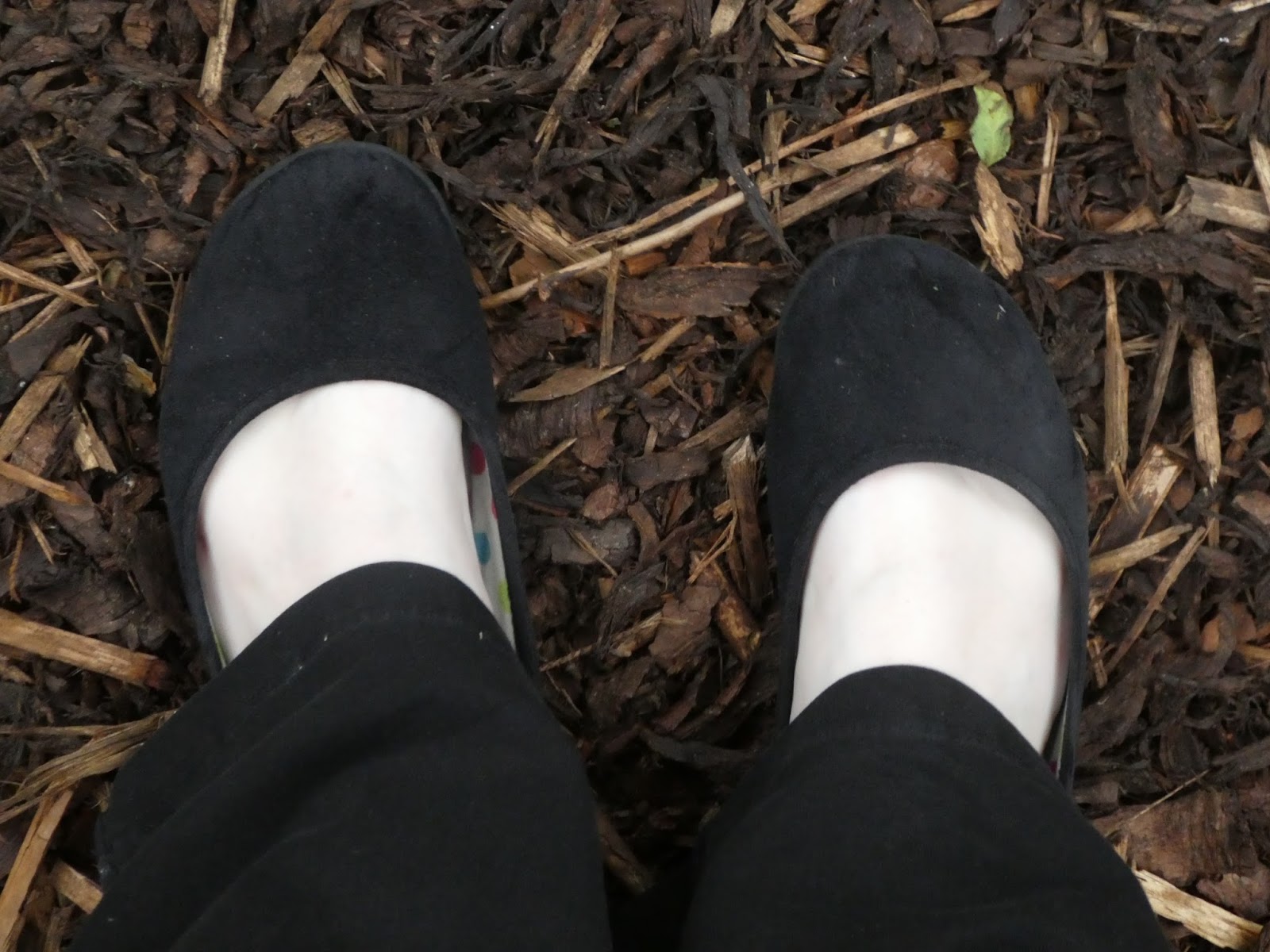
It's timely as my ME has been pretty bad recently and I've had little energy to do much at all, hence the lack of blogging. As I am not well enough to attend any actions, I'm taking part in the #MillionsMissing campaign virtually. The idea is to show a photo of some shoes, with a note that expresses a way that you are missing from the world.


If you could learn one thing about ME, I urge you to read Sally Burch's post: Well enough to drink coffee? Because ME is an invisible illness, and whilst I might look normal, I'm actually constantly exhausted to the marrow, and in most days, in lots of pain.

So if I'm not blogging much, this is why. Coz when I do have some energy, well, you'll find me in the garden :)

Saturday, 22 April 2017

Garden visit: Renishaw with friends

We visit Renishaw Hall Gardens at least a couple of times a year, and often around bluebell time. This year coincided with Easter and friends. So this is a slightly tongue-in-cheek take on visiting Renishaw Hall Gardens with friends. If you want less people and more bluebells (!), visit my 2015 post.
L-R: Manishta, Kevin, golden cupid thingy in the distance, Kate & J-P.

You get the drill, only this time with moi.

It seems hares do the cat cleaning it's paw thing. Yes, I know it's a sculpture, but my view stands.

As well as bluebells, there were Magnolias.

Manishta drinking of the wine of the Magnolia. Manishta, you can stop now. Really.

It wasn't long after this malarkey that I realised I had no energy to walk any further. We had barely got past the entrance (though I felt like I'd walked miles), but MECFS doesn't care about that. Kevin thought to go back to find out if they had any mobility scooters we could hire. They did, and the hire was free, and what's more, rather than making me walk back, they brought the scooter to me. Being able to use the scooter made all the difference. I had been thinking that Kevin might have to take me home, but instead I was able to continue to enjoy the day with my friends. Thank you Renishaw.

Borrowed landscape with cows.

One of these friends is not like the others.

Manishta: ok, I'll smile then.

Even Ms-I-don't-care-for-camellias (that's me in case you were wondering)
thought the colour looked wonderful against the bluebells.

Two heads are better than one. 

I think this is the Benny Hill element of the visit.

Girls just wanna enjoy bluebells.

Magnolia 'Vulcan'

Rubus spectabilis Olympic Double - thanks to Gill at Off the Edge Gardening for the id.
(previously labelled as a double flowered dog-rose)

Didn't catch it's name. But pretty.


 In case we missed it, J-P demonstrates the shapes arising from the shuttlecock ferns.

 Kate wonders if she can pass.

You shall not pass! So that's a nope, then.

Is she taking photos again?

 Wait for it...

What larks, says J-P.

Wait for it part 2... 

Is that a castle arising from the steps?! 

Unlike Kate, I got passed the statues on my scooter.
It was worth their wrath to see this view. 

If I was them, I'd be opening those windows in the evenings.
Coz who cares about a cold April wind when there is Wisteria fragrance, right?

T'was a wonderful visit. Made the more so because of the use of the mobility scooter. Much of Renishaw is wheelchair/scooter accessible, including the bluebell woods, and they even have a scooter map to show you the best scooter paths.

And, in case you need the incentive, they have a pretty darned good little cafe. Good for sitting in with friends eating yummy food. Both lunch, and afternoon tea ;)

Friends and flowers. It was a fab day.

OMG it ME, says Kate.

Sunday, 26 March 2017

Introducing the new garden


We have recently moved to a bungalow we are renting for a year or so, and I thought it was time to introduce the new garden. Above is a photo of what the garden looked like when we moved in.

As the move is temporary, most of my plants are staying in pots. With the ME being pretty crap at the moment, I have given thought to how I can most easily manage all the pots and gardening in general. I've been reading Anne Wareham's new book The Deckchair Gardener (a review is forthcoming). It has already helped me clarify my thoughts on parring back gardening tasks to a bare minimum, whilst maintaining the health of both my plants and myself. I'm taking to heart her challenge to be brave and question Do I have to? As a spoonie, there is a lot to be said for being a deckchair gardener.

The garden is north-facing, the sunniest place is in the top left corner. So reflecting upon all this, I have created a temporary garden for my pots. This consisted of putting down some mypex, then bark, then the plants, and voila!
Garlic containers & bricks edging the border of my container garden

I believe this arrangement, containing (tee hee) most of my pots to one area and thereby making it easy for me to do watering, should help with this. The mypex and bark will stop grass and weeds growing up around them. There is no moving them in order to mow, which would have been the case if I had just plonked them down on the grass.

The garden did have one long thin border, much of it choked with grass and weeds (right). I had my gardener, Andrea, dig these out, and I'll be making this a herb and strawberry border, with a few perennials dotted between to give a bit more interest and height. The herbs include Rosmarinus officinalis 'Blue Lagoon' and Thymus x citriodorus 'Golden Queen'.

Ready for planting

At the shadier end of this border, I've placed the pots containing plants that like more shade, direct on the soil. I have added a few favourite plants such as Primula Veris and Fritillaria meleagris, plus herbs that are happy in light shade such as Viola odorata and Oreganum vulgare 'Aureum crispum'. The plants in the ground I will all leave for future renters. Apart from anything, every garden should have a few herbs.

A new small border will be added along the back fence to right (again, I'll get Andrea to dig this), into which I'll be planting my comfrey, 'bocking 14'. It's currently in a pot, but comfrey really needs space in order to really grow so it's roots can obtain the trace minerals etc that make comfrey liquid such a useful fertiliser. I'll also add a few stray Digitalis and Stipa tenuissima that could do with a home. Very low maintenance, and the bees will love me. It's always good to be on the right side of the bees.

One area was a mystery.
Huh?

Andrea dug out some of the weeds and we discovered there was a Peony hiding under all that grass. I'm guessing the previous tenants weren't gardeners. We are going to try and tease out more of the weeds, though it's doing rather well despite them.


Otherwise, that's it. The rest of the lawn will get a monthly mow and the hedge trimmed, again by Andrea. My main tasks for much of the year shall be a little seed sowing (a few Spoonie Veg in pots), at little weeding, quite a bit of watering (all those pots), but with the hose because it's easier.

My aim is to be able to enjoy my plants, harvest a few veg, and sit in my comfy chair and enjoy the garden from the comfort of my 'deckchair'.


My thanks to my partner Kevin and friend J-P for getting up my arch. When the arch is up, I'm home.